
Have guitars, will sing
The Whiffs prove that melodic, urgent rock and roll is alive and well

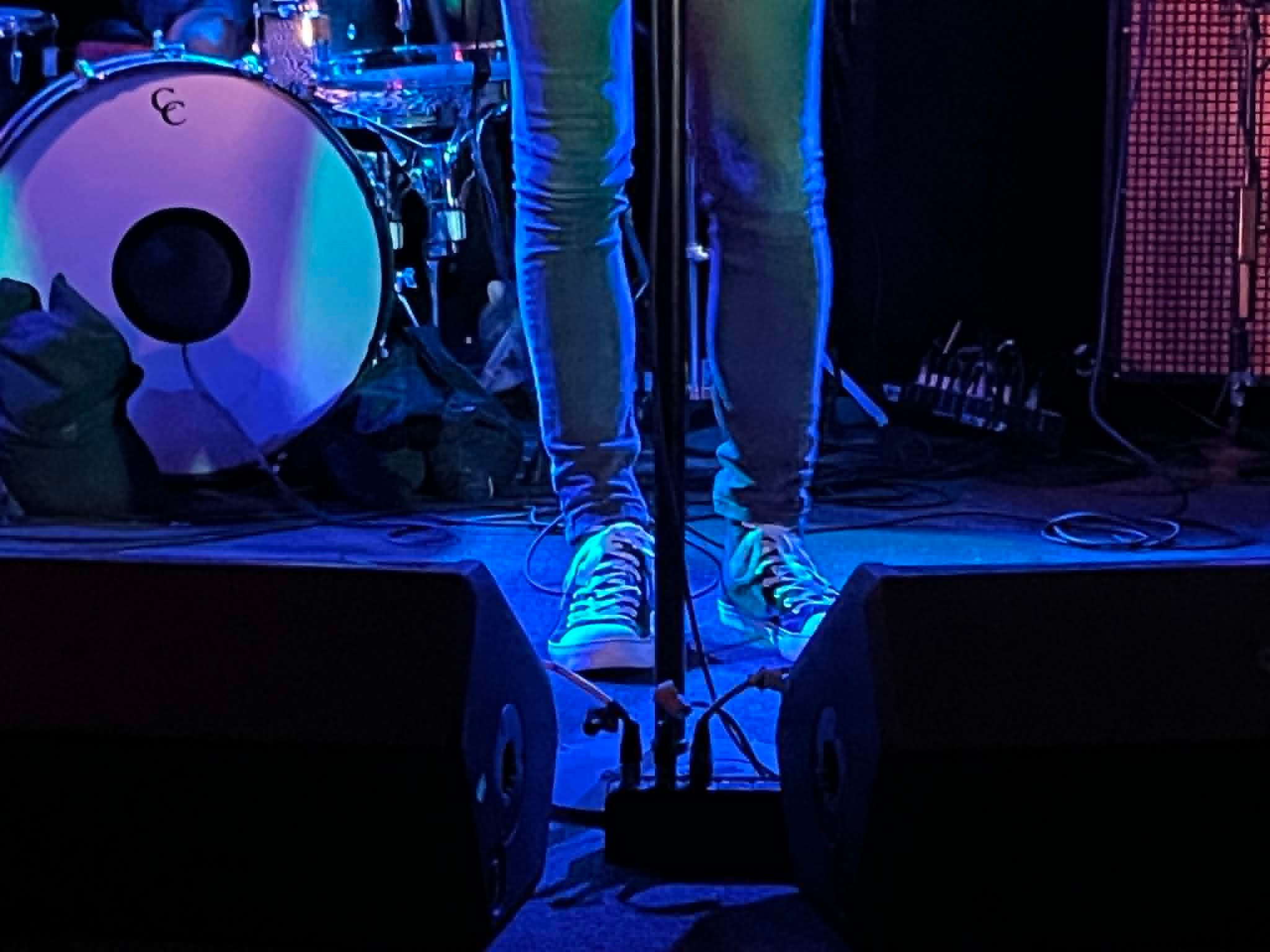
DOWN AT THE ROCK AND ROLL CLUB—Kansas City’s Whiffs rolled into Chicago Thursday night, and their tuneful, driving power pop delighted a small crowd at the Empty Bottle. The Whiffs are a sonic tonic these days. Their amped-up and riff-driven songs are richly melodic, propulsive, and catchy—the day after the show, I woke up with one of them in my head—and their presence onstage is a restorative reminder of the camaraderie and good will that can glow from a stage when pals are making music.
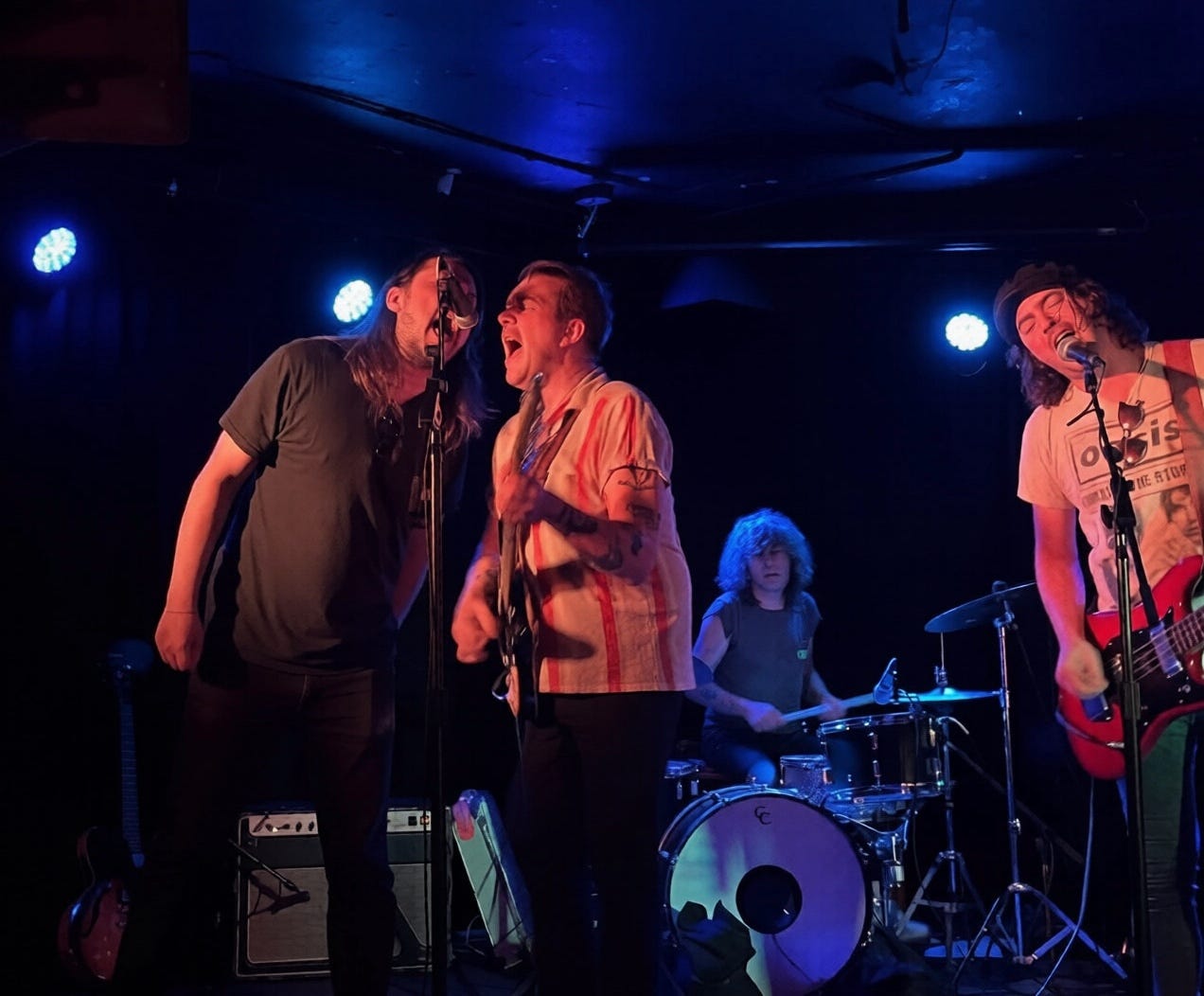
The Whiffs are comprised of guitarists Rory Cameron and Kyle Gowdy, bassist Zach Campbell, and drummer Jake Cardwell. To my ears, as solid and memorable as the band’s strongest songs are, the strength in their sound derives in no small part from Cameron’s powerful vocals. Onstage, with his short hair, inked-up arms, orange-and-white striped shirt, and black pants above white sneakers, he gives an Eddie Cochran-cum-Brian Wilson look, yet his voice howls from a different tradition. He evokes a run of expressive singers, with touches of Phil Lynott, early, hungry Bruce Springsteen, and Paul Westerberg, while borrowing heavily from Real Kids’ John Felice, Paul Chastain, and the late Adam Cox from Exploding Hearts. Yet: Cameron’s voice, grainy and raw in the best ways, is all his own, in service of passionate pop songs about love and loss. I observed him between bands committedly smoking on the corner of Western and Cortez, outside of the Bottle. Limbering up, as it were.
Campbell took the mic for half of the set, his songs driving and urgent too in their melodies and changes; at a slightly higher pitch, his voice caresses the songs rather than attacks them. Onstage, tall and rangy, wearing a black peaked cap, an Oasis t-shirt, and stovepipe jeans stuffed into band-approved Chucks, Campbell gave the impression of the benevolent older brother, jovially impatient while Cameron repeatedly stole sips from his bottle of beer and insisted on tuning up. (Cameron moved between a twelve-string Rickenbacker and a gorgeous sunburst Gibson; he had many strings to attend to.) Impatient to count off the songs and to keep the momentum going, Campbell exuded an appealing, downed-wire energy—this contrasting with Gowdy, who, standing aloof on stage left, gave the impression of being in a different band altogether as he played lovely lines and leads, his head down, fascinated to work out the equations materializing along the neck of his guitar. (He emerged from behind his work desk to sing one song.) Meanwhile, Cardwell energetically bashed away all night, his Joey Ramone hair keeping its own time.
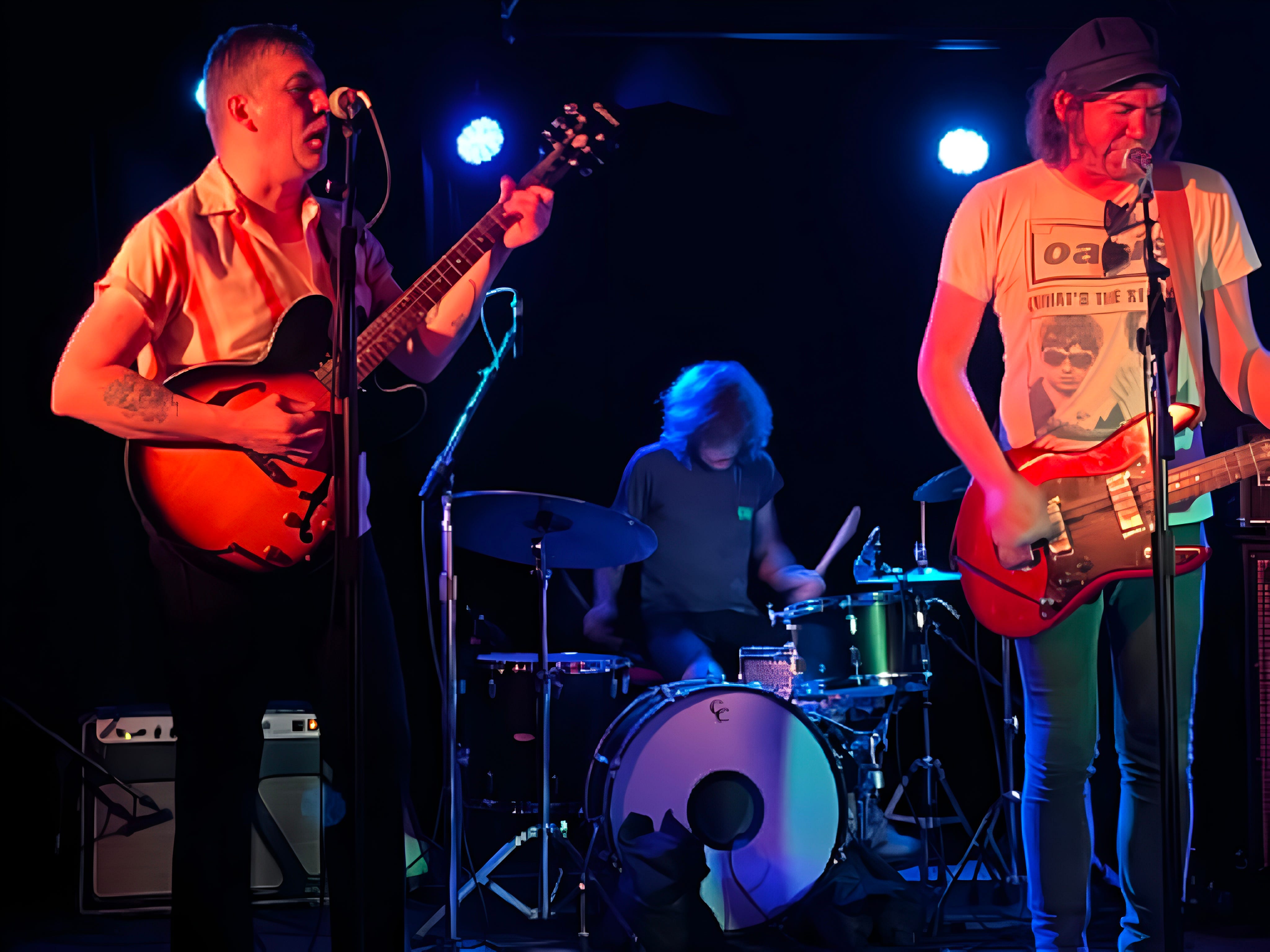
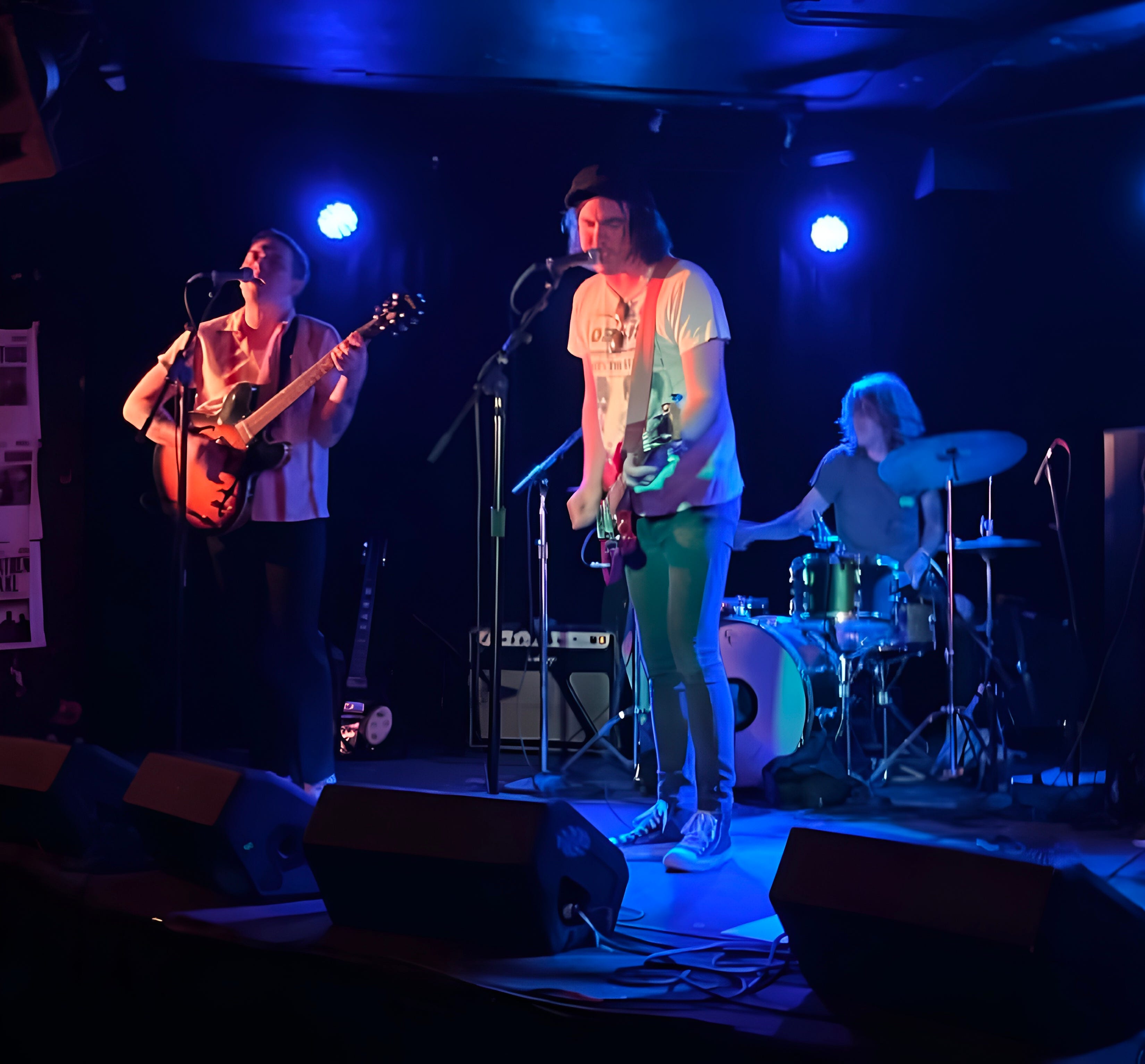
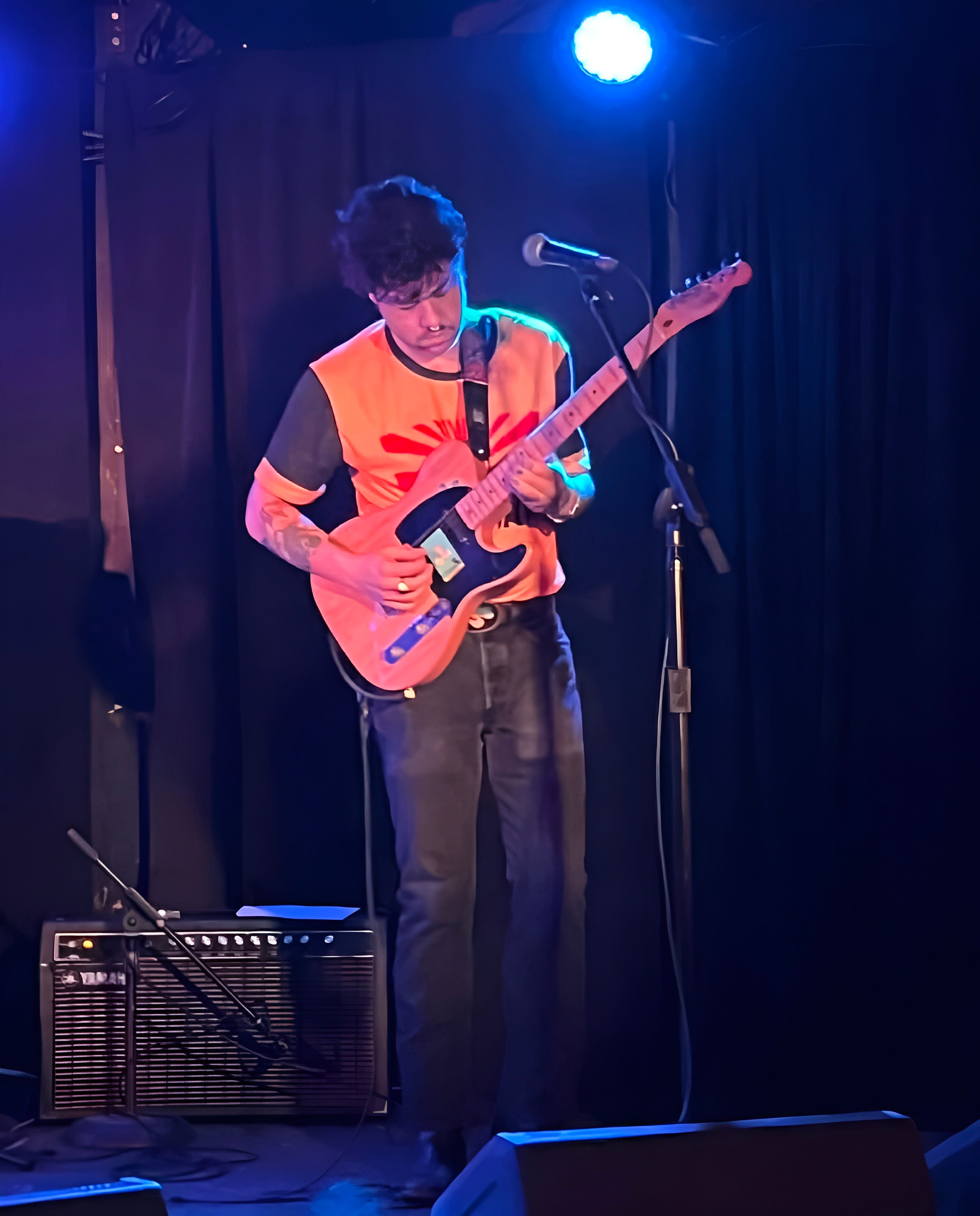
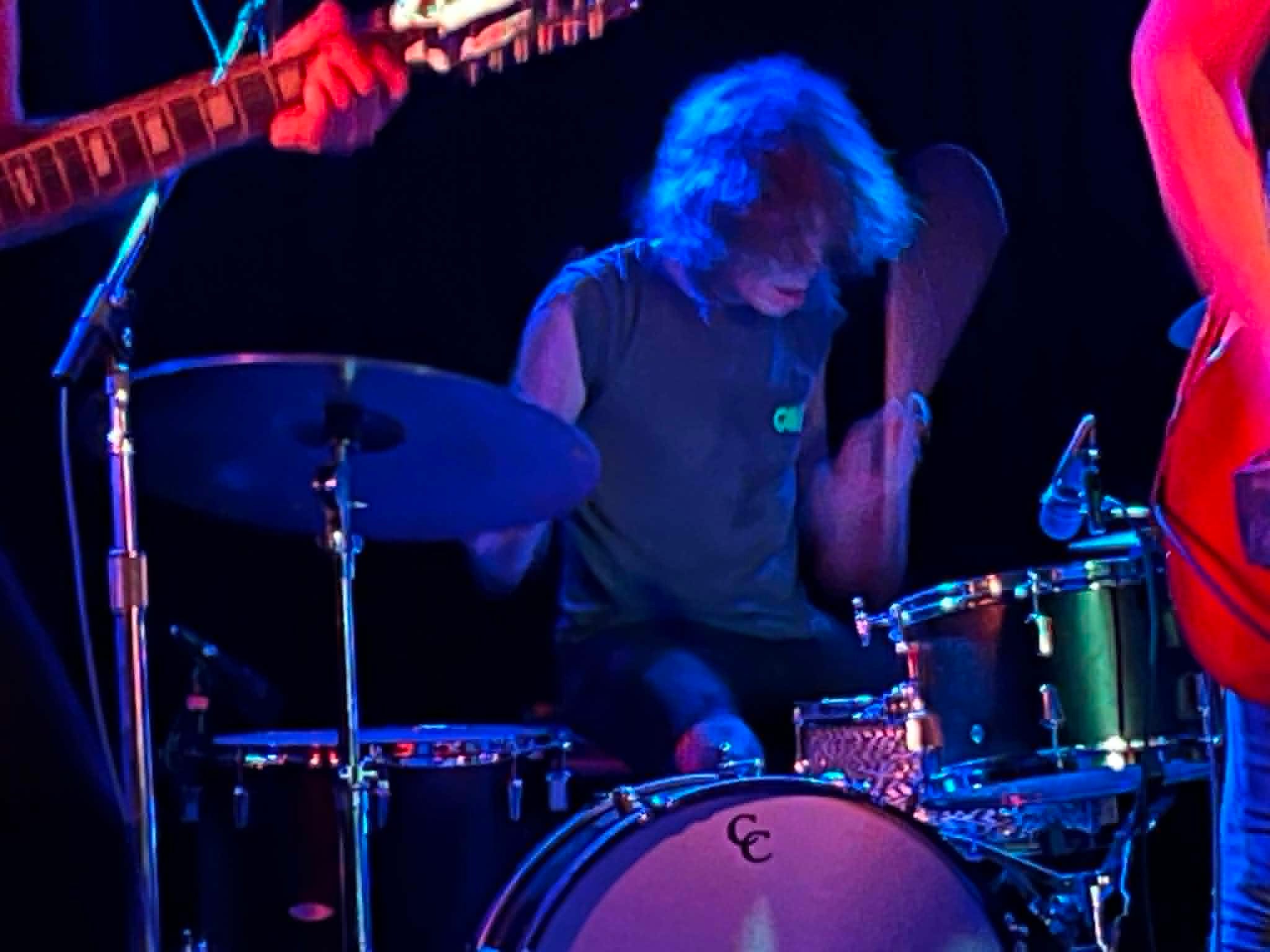
The set list was stocked with new songs. Cameron announced that a fresh full length album—the band’s fourth after Take A Whiff! (2017), Another Whiff (2019), and Scratch ‘N’ Sniff (2023)—will be released this fall. (No word on whether they’ll continue with the inhalatory title theme.) The clutch of unfamiliar songs and the sparse crowd challenged the room’s energy a bit—this was one of those nights where in the between-song silence you could hear the amps hum and where a band member’s “Y’all ready?” asked off mic could be heard at the back bar. “When you’re in the studio, you are focused on the energy of the take vs. the energy of feeding off the crowd around midnight in a dive bar,” Campbell remarked to Nick Spacek at The Pitch a few years ago. “Songs also morph the more you play them live. Sometimes I know I’ll do things differently vocally, and I hear Rory…do the same or add a lick on the guitar. Jake also will come up with a killer drum fill that maybe wasn’t around yet when we did the studio take. All those things usually make me smile.”
Campbell was smiling onstage for sure—none of the challenges at the Bottle dampened the affable band’s energy on this night. The new songs, the abundance of which the band apologized for but all of which were well received, were terrific and sturdy. I especially dug “Is This Love Again,” “The Mystery,” and “I Could Still Be King.” Cameron claimed onstage that the band was “sick of the old songs,” but then he promised a few, and near the end of the set the band obliged with the terrifically catchy “Wanted” and the galloping “On the Boulevard,” from Scratch ‘N’ Sniff and Another Whiff, respectively. The evening ended with a rousing cover of the Replacements’ “Can’t Hardly Wait,” the fellas inviting a couple friends onstage to gang holler along, everyone up there and in the crowd delighted to plug in to an old favorite made new yet again.
When my literature students and I would have conversations about genre, I’d invariably haul out a fantasy of mine: rather than the Library of Congress disputing genre lines, every book that’s ever published—print anyway—would be tossed onto a giant, ever growing hill, stripped of a genre tag. Want a book? Just reach in a grab one from the immense pile; you’d be unaware of its genre and unburdened of whatever preconceptions and expectations you might bring to reading it. Are you reading a novel? A memoir? A biography? Prose poems? Who knows?
I have genre on the mind these days. I was happy to have been invited by S.W Lauden to contribute to his revived series “Is It Power Pop?!” at his terrific Substack, Remember the Lightning. (Look for my piece in a couple of weeks.) Providentially, the Whiffs, who seem to happily embrace power pop as a descriptor of the tuneful noises they make, rolled into town just after I finished writing the piece. At VWMUSIC, Andrew “Vinyl Writer” asked Cameron about the Whiffs’ influences, noting that the band’s sound “has such a vintage vibe to it, but still sounds fresh all the same,” highlighting Ramones, Big Star, and latter-day Replacements as touchstones. “We’re definitely all Beatles fanatics in the band but that’s sort of a given,” Cameron replied. “I learned how to play guitar to Elvis Costello’s My Aim Is True, which I think definitely shows in some of my songs. I love Nick Lowe as well. But I always have a habit of tracing back the influences of the artists I like, so a lot of 60s and 50s music is in the wheelhouse for our maybe more 70s sound.”
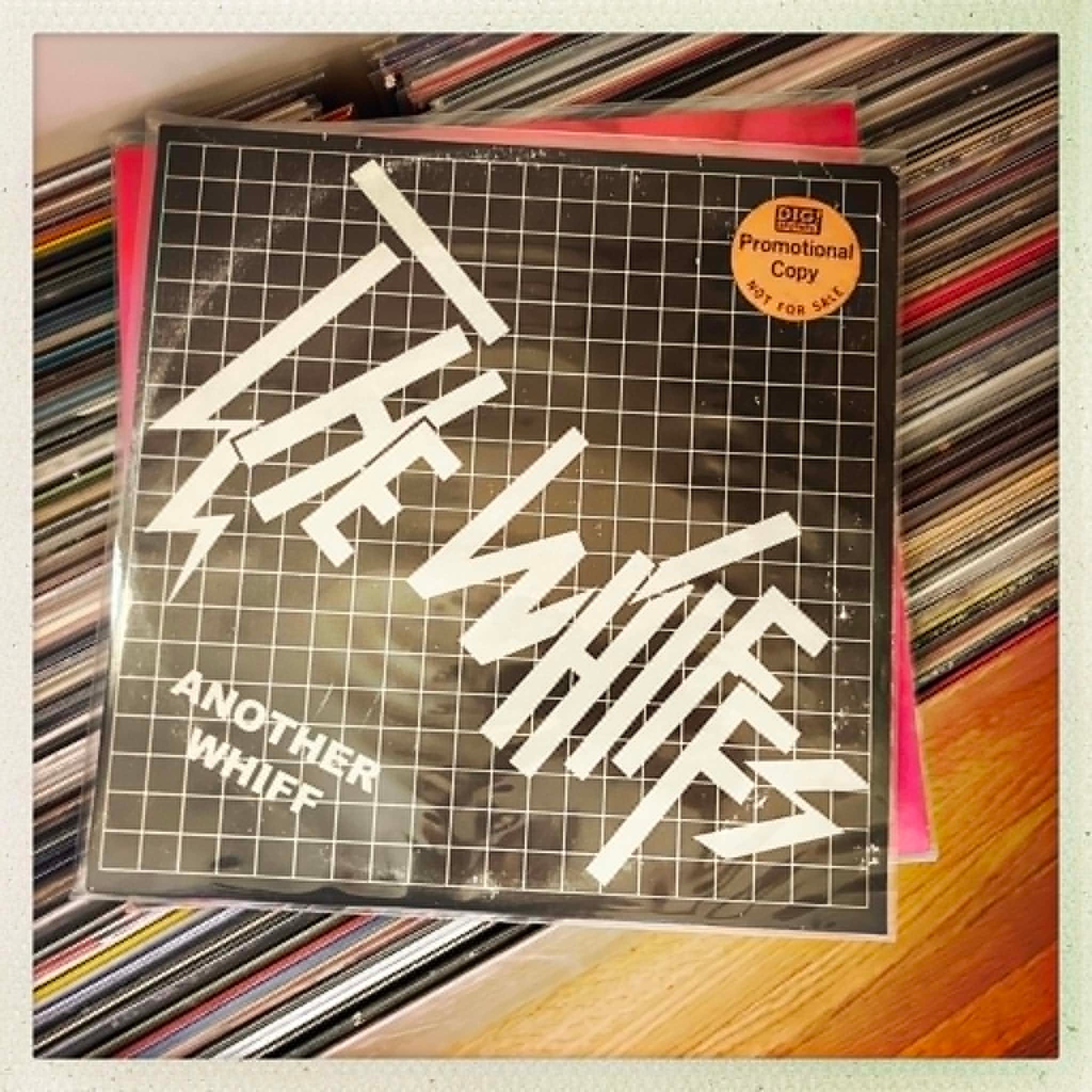
The Whiffs’ best material transcends any labels, floats above our heads, as the best pop music does, shorn of identifying labels beyond Good Song, Great Tune, or Even Better!. Onstage at the Bottle, Cameron’s twelve-string rang out cheerily, but it thickened and added muscle to the songs also, a complement to his rough-hewn singing. One of the Whiffs’ songs that I’d hoped to hear, perhaps because, darkly shaded, it pulls away a bit from the band’s bright power pop influences, is “My Vision Of Love,” from Another Whiff. The tune begins with a nod to Hoodoo Gurus’ sublime “Bittersweet,”—you’d be forgiven for thinking that this was a cover song—but the arrangement rumbles and tumbles, and Cameron’s vocal is so hoarsely charged that within a few bars it’s clearly the Whiffs’ only. It’s an old story, but so desperately winged that the singer’s hungers feel brand new: he’s got no money (he “spent it last week”—a great detail, versus the shopworn “last night”). He can’t win and yet can’t stop himself from ringing her doorbell, his vision of love the only thing that night that’s keeping him right. He could use a lucky break or three, and if she’d let him inside then everything might feel not only possible, but likely.
The guitar solo, as in the best rock and roll, declaims everything that the singer can’t yet, threatening to derail things until that passionate chorus returns. It’s great, and really sexy stuff. The singer’s desperate to see her face. Maybe I’m a pessimist, but I imagine his desperation to score with his vision—or just to see her in an open door—burning out into ambivalence, the age-old tale of the man who can’t stick the landing, who’s gotta move on, restless.
I was happy when the Whiffs pulled out “Wanted,” a chiming groove of a song about loss, the wonderful chorus of which makes that loss bittersweet. In under three minutes, Campbell sings about someone who wastes his time and hangs it on the line; she asks him why he should feel so sad, he sees her doubt, and that’s all that he really had. The lines,
You walked away, could’ve easily have stayed
You hurt my pride, I hope you’re feeling satisfied
are dryly stated, leading back, like the scratching of a stubborn itch, to the sweetly sad descending melody in the chorus—“But it’s all you ever wanted to do”—where the singer’s always, sorrowfully, pulled back. A melancholy pop song: clarity and the balm that soothes it, rueful knowledge made pretty by a melody. “Wanted” was a crowd pleaser at the Bottle, not only because it was one of the few songs familiar to the crowd, but because the story, sung by one person on a stage in a city on a Thursday night, was everyone’s story.
Asked in 2021 what his thoughts are on punk, Cameron replied, “I think punk is whatever it wants to be. As a teenager, I got turned off by how homogeneous it had become in the early aughts. Punk to me was this revelation that I’m allowed to be myself and like whatever I want, and fuck you if you have a problem with it. I get pretty annoyed by this contrarian attitude of people hating on things that aren’t quintessential ‘punk.’ There is plenty of music that is most definitely not Punk that possesses the same spirit.”
That spirit—damn the genre that it’s wrapped in—was alive at the Empty Bottle, where the Whiffs proved again that melodic, urgent, guitar-driven rock and roll is alive and well, valuable, even. As esteemed power pop emeritus Pete Townshend was once heard to observe, “Rock ‘n’ Roll might not solve your problems, but it does let you dance all over them.”
You might also dig:
Kate Clover wants it now

DOWN AT THE ROCK AND ROLL CLUB—Watermelon, a Chicago band that self-describes as “super sour punk,” opened last night at Cobra Lounge. I noticed right away that the drummer was sporting a Hoodoo Gurus t-shirt. A good omen, I thought.
Those Saturday nights

DOWN AT THE ROCK AND ROLL CLUB—Even if you weren’t drinking at the always raucous Liar’s Club on Saturday night, you left with it on you. Beer was in the air, literally.
Lucky for life

The young Detroit band Mod Lang is comprised of Antonio Keka and Alex Belfie on alternating rhythm and lead guitars and vocals, Ava East on bass and vocals, and Ben Taber on drums. They self-describe as “Pop n Roll.” Lift the proverbial lid on their sweet and rousing debut album
Photos of the Whiffs at the Empty Bottle, Chicago, July 23, 2026 ©Joe Bonomo