
Please be upstanding
XTC wrote brilliant pop songs about limitations, boundlessness, and the charms of simplicity

For more than thirty years, Andy Partridge wrote off-kilter pop songs about ordinary folk floored by the beauty and strangeness of the universe, witty and angular tunes that moved between sweetness and nerve. They were salvos against suaveness, worldliness, and pretension, rock and roll for ironists who curated alternative Top 100 charts.
I loved XTC immoderately in the 1980s, digging them, in part, as the dutiful English major I was. I always felt that Partridge, and longtime bandmate, songwriter, bassist, vocalist Colin Moulding, would’ve swung quite nicely with the English Romantics, whose poems were then knocking me out in my literature classes. Heart-bursting emotion, love for the charms of the natural world, the privileging of the imagination and wit over reason and logic: all were firmly in Partridge’s wheelhouse. (His band’s name says ecstasy.) That XTC’s songs were as fun, aggressive, and tuneful as they were bookish, sealed the deal for me, and for many of my like friends. At the time, I intensely identified with Elvis Costello’s acerbic, literate wordplay also, but I loved the skewed sweetness and humility in which XTC trafficked, too.
So, I come in praise of a particular kind of pop song. Partridge allegedly wrote the brilliantly titled “When You’re Near Me I Have Difficulty,” a track on the band’s third album Drums and Wires, released in 1979, about a girl on whom he crushed in school. Partridge was a master at evoking the tongue-tied agonies of adolescence, just one quality in his songwriting that endeared him to so many. The song opens with the gasp and thud of the heart as the beloved comes near, then spends three minutes catching its breath. The syncopation among Partridge and Dave Gregory’s guitars, and Moulding’s bass and Terry Chambers’s drums is misleading: those tightly controlled, efficiently moving parts are actually churning up the singer’s insides. Until her arrival—in the schoolyard? the hallways? those delectable dreams at night?—the singer was in a “noble, immovable state,” an “iceman, living in an iceman town,” merely a “piece of emotionless wood.” When she steps near, he has trouble breathing, focusing, standing up, and yet he happily devolves:
Now I’m feeling like a jellyfish
Just a spineless, wobbly jellyfish
And it’s great, great, so great. This eight-bar bridge is the veritable soundtrack of infatuation, as a fluttering arpeggio on guitar and a dizzying, shivery line played on a synthesizer evoke the singer’s light-headedness. In the brutal agonies of a cheery pop song, the bridge gives way to the perversely pleasurable anxieties and rapid breathing in the verses and the chorus. And the fade out mocks the obsessive tape-loop of his difficulties. Poor guy.
“Rocket From a Bottle,” from the band’s follow up, 1980’s Black Sea, also begins in medias res: the rapid heartbeat of an inarticulate kid. Partridge brilliantly ups the ante in the song’s introduction, with the breathless approach of “I…, I…, I…” followed by the chastened retreat of “oh, oh, oh, oh,” graphically evoking the singer’s bursting wish to sing just as his language fails him. (I’ve always felt that these eights bars are quintessentially XTC.) But he’s a far happier kid than the singer in “When I’m Near You I Have Difficulty”; the trouble here is in containing himself. “Birds beware,” he demands, gazing upward—
Me and air are feeling light today
Jets should hide, I’ll fly alongside
Me and pride are bolted tight today
—as eighth notes played on a keyboard gulp the air, and Moulding and Chambers dash to keep up. We soon learn the reason for the singer’s airborne joy: “I've been set off by a pretty little girl,” a phrase sung as a kind of schoolyard chant, it’s his heart’s own “nyah nyah nyah nyah nyah nyah.” You can practically see him skipping away as he sings it. He’s feeling in love, that’s all and that’s everything, the titular rocket from a bottle shot free, and the best way to sing it is to look triumphantly to the sky: “I’ve been just explosive since you lit me / I’ve been up with the larks / I’ve been shooting off sparks…,” “I’ve been up in the clouds / I’ve been shrugging off shrouds.” Gregory’s ascending guitar solo only confirm’s the singer’s joyous mood.
There are wags online convinced that the song is a winking, barely-coded allusion to ejaculating. I used to think that too, smut perennially on my mind in my teens and twenties, but in the decades since I first heard and was transported by the song, I’ve come to feel that such a reading’s reductive. “Rocket From a Bottle,” as with so many of Partridge’s most—well—ecstatic songs, is about release of the heart.

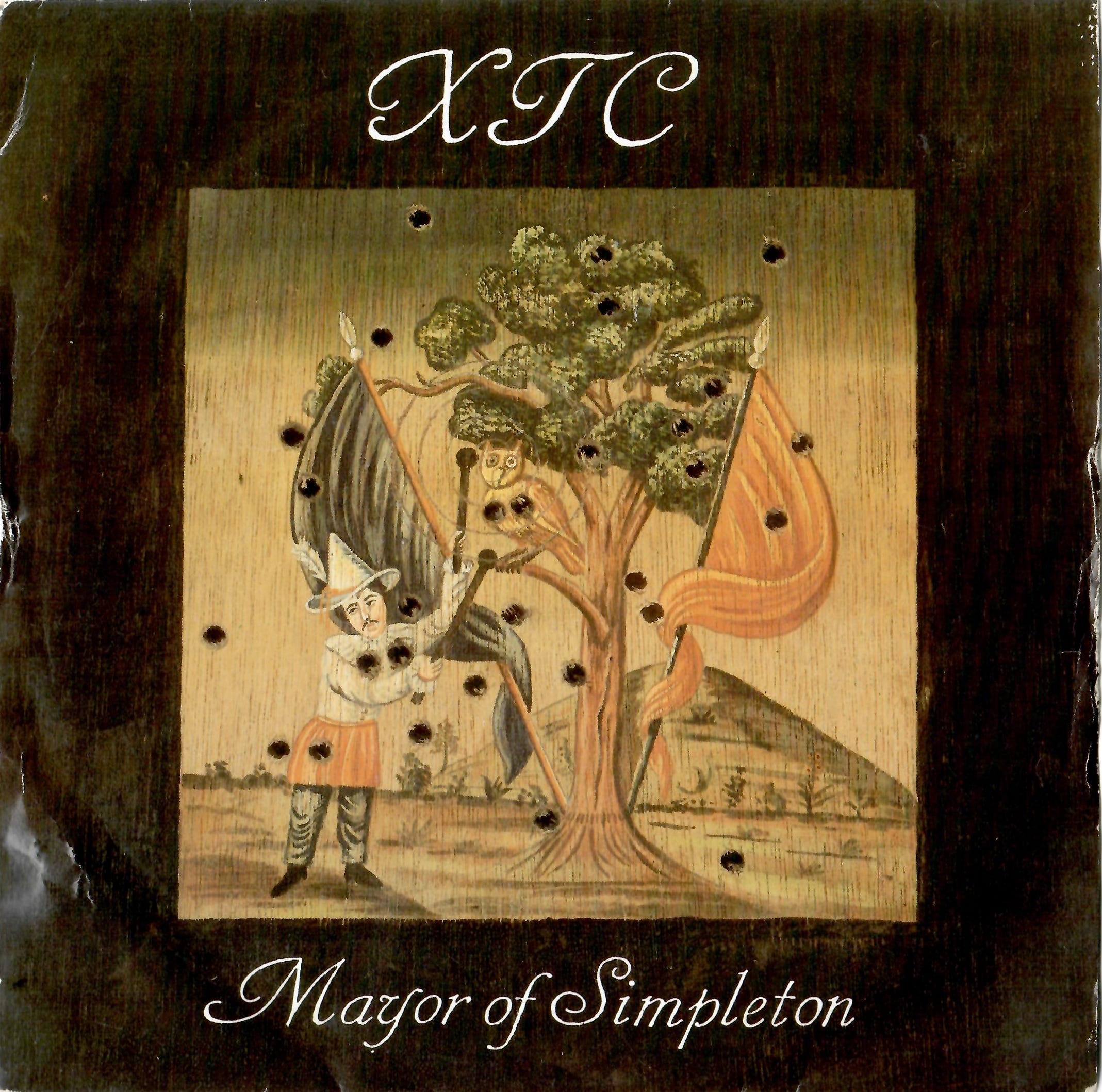
At the end of the 1980s, Partridge and XTC released Oranges and Lemons, the title allegedly a reference to their woeful collective bank account. Indeed, the band never scored the massive, worldwide hit that that they (and many other bands and artists) deserved. In the event, Oranges and Lemons would end up becoming XTC’s highest-charting album since English Settlement (released in 1982), hitting number 28 in the U.K. and 44 in the U.S. And it featured their only U.S. single to chart, the sublime “Mayor of Simpleton,” perhaps the apotheosis of Partridge’s odes to the common man.
In an essential series of conversations with Todd Bernhardt in the late ‘00s, Partridge discussed his songwriting processes; to Bernhardt he admitted that while writing “Mayor of Simpleton” he’d borrowed the chord sequence from Blue Öyster Cult’s “(Don’t Fear) The Reaper.” (If you’re a guitarist, the sequence is C, D, and open G, moved up a tone to become D, G-flat, open G.) “I’m not joking!”, he said. “I thought, ‘Wow, isn’t that a bit like ‘Don’t Fear the Reaper’? How does that go? No, that’s not it, but that’s not bad! That’s pretty good, in fact. It’s got an essence of the Byrds about it—that big, ringing open-G thing—but it’s nothing like Blue Öyster Cult.” Guitar in hand, Partridge wondered at once if he could fit the lyrics to “Mayor of Simpleton” over the sequence.
“I was kind of blundering around with someone else’s song, and made the mistake of finding the ‘Mayor’ riff—it was not what I was looking for, but I found something all my own.” Later he remarked, “Sometimes you can make a great roof, but the building it’s on top of is just not happening. You know, you’ve made the roof of the Louvre or something, and put it on top of a mud hut! So, you mess around a bit—and in my case, I blunder— and then suddenly you sometimes find the key to the rest of the building under it, and you keep at it until it looks in proportion.”
What he discovered in channeling Donald “Buck Dharma” Roeser was a sequence that—once fused with Moulding and session drummer Pat Mastelotto’s driving rhythm section, and his own appropriately plain melody—provided propulsion for a confident lyric about the charms of emotional and intellectual modesty. (“I wanted it to have a fleetness of foot,” Partridge said of the chords, “a joyousness to it.”) Partridge’s smart and witty lyrics are among his most appealing, the affection he has for his humble subject palpable. The singer lacks a college degree, doesn’t read much, sweats it out in front of challenging crossword puzzles. And,
I can’t unravel riddles, problems and puns
How the home computer has me on the run
…
I don’t know how many pounds make up a ton
Of all the Nobel Prizes that I’ve never won
But, though he may be a self-described Mayor of Simpleton, mocked and ridiculed by his peers, he does know one thing, “and that’s I love you.”
“I guess I’m being a little bit of a fibber in this song, because I’m not a stupid person,” Partridge remarked to Bernhardt. “I suppose it’s saying that emotion, and the warmth of emotional honesty, is better than some sort of stinging, cold, rather antiseptic brain power. It’s better to be not so intelligent and more loving—quite a simple message.” He acknowledged that there was an autobiographical angle to the song, as well. “I recently found a load of my school reports. You look at them, and you can just see my interest in school going down through my teenage years. In my first school reports, I’m pretty good a lot of things, and then I really lose interest. You can see that I’m just not bothering by the time I’m 14 or 15—I’m just not bothered with school at all.”

Echoing the grim, classist fate that George Orwell described in his great essay “Such, Such Were the Joys…,” Partridge admitted that “it was largely expected that I would fail at everything.” And yet, he knew that he cared little for formal schooling. “I decided to leave school at 15, rather than go on to grammar school and do another three or four years or whatever it was.” He added, “I couldn’t wait to get out of school. I detested it. I detested the idiots—the idiot teachers, the idiot pupils even worse. I was bullied a lot because I was sort of weak and thin and artistic, and I didn’t like sports.” Partridge did eventually make it to Art School later. “Yeah, at one time I thought I might want to be a graphic designer. Now that surfaces in sleeve designs and other stuff, but I very soon found out, after a year and a half or so at college, that it was just school, too. And of course by then I was getting more and more interested in making music, and I had this craaaazy fantasy that I could have a career in music.”
“Mayor of Simpleton” is a sly, winning ode to unassuming confidence, modest pride, and authentic emotions. “If depth of feeling is a currency / Then I’m the man who grew the money tree,” the singer claims, promising that “When their logic grows cold and all thinking gets done / You’ll be warm in the arms of the Mayor of Simpleton.” Moulding and Gregory charmingly urge the listener to, please, “be upstanding” and salute the simple singer, meager as he may be in book smarts. In the song’s terrific bridge, the singer acknowledges that he takes little pride in never having “learned much,” he just needs to state a—yes—simple fact: “What you get is all real, I can’t put on an act / It takes brains to do that anyway.” I love how that line deflates at the end, a sonic shoulder shrug from a man who knows his limits, and yet how vast is his promise. (That self-deprecative, “And anyway.”)
Any quibbles I have with “Mayor of Simpleton” come down to Paul Fox’s of-the-era production. Fox, who’d later work with the Wallflowers, the Sugarcubes, Semisonic, and others, smooths XTC’s sound to a bright surface sheen, the guitars and drums sounding hermetic, with little “air” allowed in to let the instruments and the studio itself to breathe. (It worked: the band scored a hit!) Yet more and more, I wonder if my perennial crabby complaints about “‘80s production” have more to do with the inevitability of history than with individual aesthetic choices by artists. The band’s songs, on the main, transcend the era’s mainstream tastes in sound and texture. My ears, and preference, versus yours.
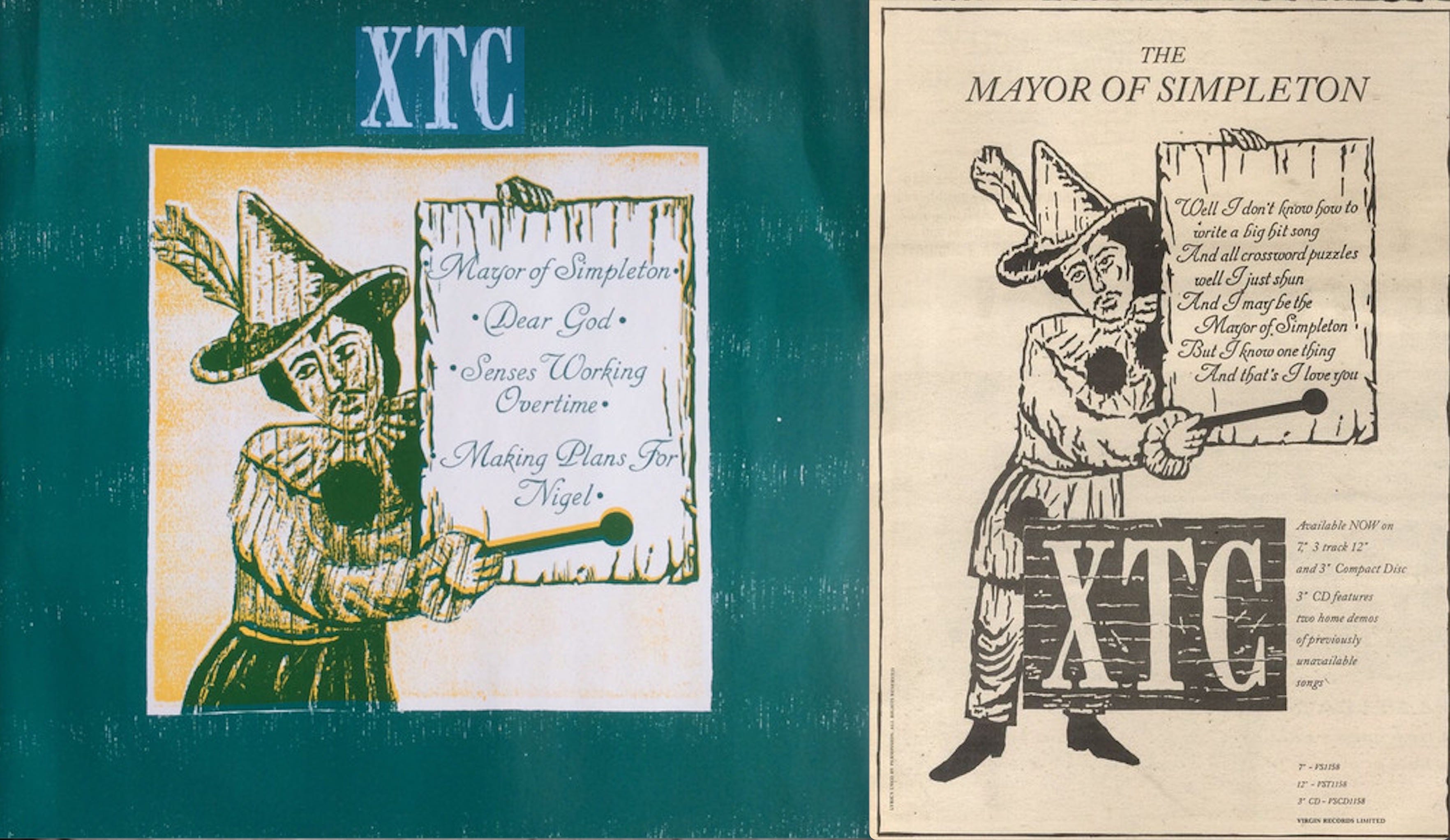
XTC often traded on an other-century, populist pastoral image, in both their songs and their album and singles artwork. I love the imagery that graced the U.K. 12” release and the promotional material for “Mayor of Simpleton” 45 (above). The town crier displays a banner for all to read, presumably in the public square or outside of the local pub, where the great unwashed and untutored congregate, far from the ivory towers.
I must say that—to my ears anyway—XTC’s quirkiness was a bit much at times, their songs too interested in their own conceits, the result being a theoretical feel to some of them, especially the later, ornately-crafted material. Partridge and Moulding on occasion over-indulged their nostalgic, Romantic longings, casting about in the bitter urban contemporary world for easy targets. But at their best, XTC produced a handful of eternal Post-Punk masterpieces (“Respectable Street,” “Generals and Majors,” “Senses Working Overtime,” “No Thugs in Our House,” “Mayor of Simpleton”) and a veritable treasure chest of minor jewels (“Statue of Liberty,” “Life Begins at the Hop,” “Love on a Farmboy’s Wages,” “All You Pretty Girls,” “Grass,” “Earn Enough For Us,” “The Loving.”) For the record, I found “Dear God” obvious and hectoring; a Catholic-turned-agnostic by my twenties, I rolled my eyes at having to love the song because so many of my friends did. Truth be told, I fell away from the band after 1992’s Nonsuch. They had two albums left in them, calling it quits in 2006.
“You can’t be precious with your own material,” Partridge said. “You’ve got to get the knife into it, and cut it up and hack it about, and be very uncaring about it. Because if you don’t, you’ll never find the potential goodness in a lot of it. You’ve got to get in and hack away the dead wood that comes along with a lot of ideas.” Please be upstanding for a master craftsman.
You might also dig:
Trying to take this all in

I wrote recently about Robyn Hitchcock’s wonderful new memoir 1967, which led me back to Hitchcock’s Soft Boys and solo work, which led me to Hitchcock’s 2019 collab with Andy Partridge of XTC—which reminded me of the piece below that I wrote about XTC’s “Senses Working Overtime,” one of the most remarkable singles of the 1980s. Some of you might’ve mis…
All part of decency's jigsaw

There are some dated moments within XTC’s terrific run of albums in the 1980s (Black Sea, English Settlement, Mummer, The Big Express, Skylarking, and Oranges & Lemons) where the studio-finessed, contrived productions can sound fussily splashy. But great XTC songs transcend the origins of their composition, to paraphrase Joyce Carol Oates. Songs like “G…
Maybe it's a conspiracy

I came late to Gary Walker and The Rain, the band that drummer and singer Walker formed after the Walker Brothers broke up in 1967. Recording for the Philips label, the group cut a handful of singles and one full-length, the hopefully titled Album No. 1
12” sleeve image and promotional materials for “Mayor of Simpleton”via Discogs
Nice. “Don’t Lose Your Temper” is my absolute fave. “Life Begins at the Hop” and Generals and Majors” right up there. So much great stuff in the late 70s, early 80s.
I had to look up the release date for “Oranges & Lemons”, as it always had, for some reason to me, that snap, crackle and pop of springtime springing around the world. The artwork, that Paul Fox production, the tunes all felt like sun burning away the gray and snow of winter. Alas, yes, the release date: February 27, 1989.