
Alone in the crowd
Phillip Lopate is one of our great writers on the pleasures and the pitfalls of urban life

Phillip Lopate will turn 83 this November. In August, he’ll publish his fourteenth book of nonfiction, A Washington Irving Sketch Book: Reflections on an American Writer, with Princeton. I can’t say that I’m a fan of Irving’s—if only because I’ve read so little of his work. But I’m an enormous fan of Lopate’s, and I’m certain that I’ll find his latest book as absorbing as his others. Among Irving’s qualities that appeal to Lopate, in addition to his New York City biography (he was born and raised there), is that Irving was “a lifelong bachelor, he was urbane, popular, and socially adept, mixing with royals as well as paupers, yet underneath it all he was a loner and a melancholic.” Minus the hobnobbing with royalty, Lopate has made a career of exploring these stubborn traits in himself. I’m looking forward to seeing where Lopate follows Irving and if those trails will inevitably lead back to Lopate.
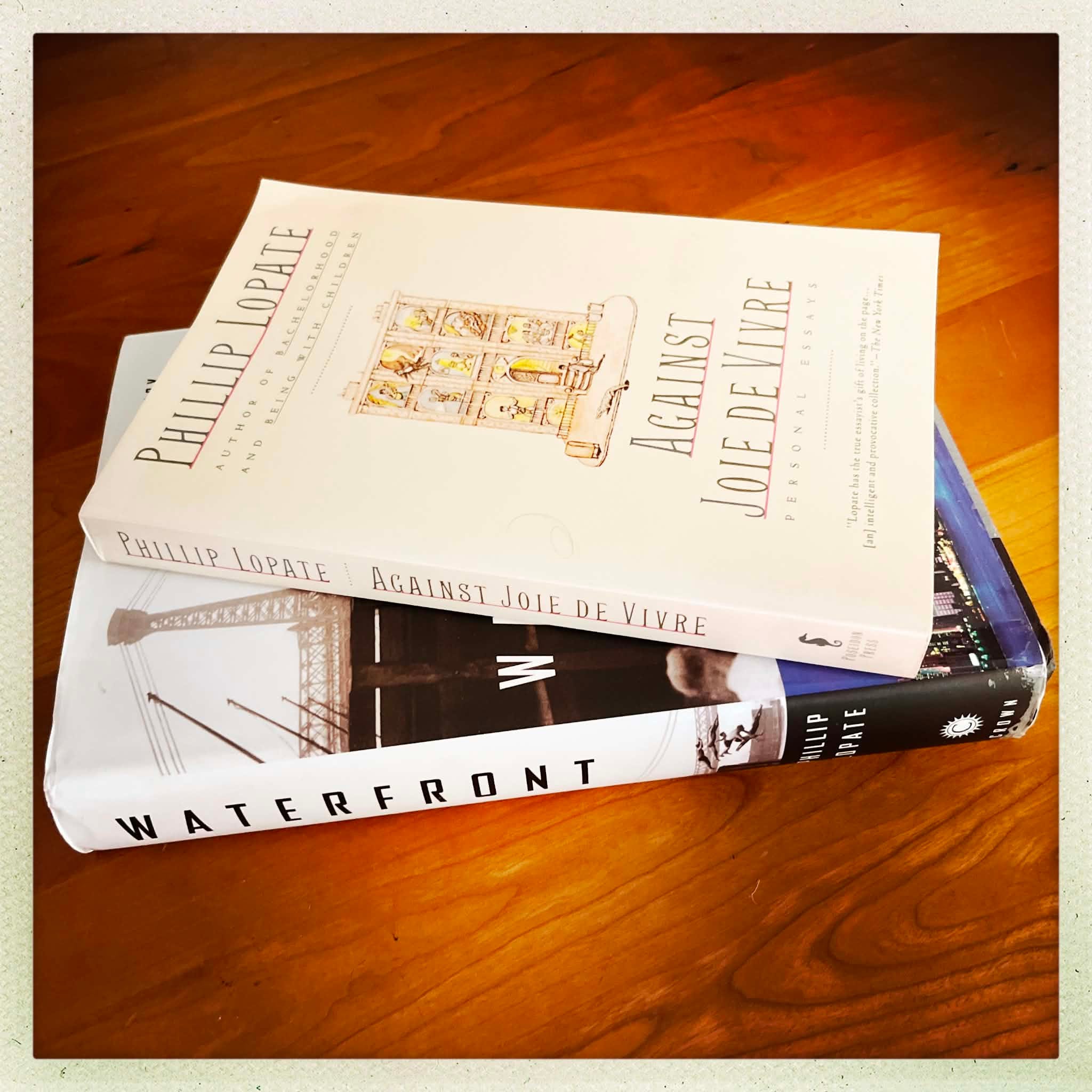
During the pandemic lockdown (which depending on the day feels far away or too near), Lopate’s writing was a great balm for me. His skepticism, humor, and self-effacement were tonics against the global anxiety that we manifested stuck at home. As with almost everything I read, watched, or listened to in these days, I stumbled on ironic notes that were unintended by the writer. In his terrific “A Passion For Waiting,” in Against Joie De Vivre (1989; reissued by Nebraska in 2008), Lopate confronts his distaste for hanging around in for long hours bars and coffeehouses. What a luxury that was to chide oneself for in 2020 and ‘21! The hours that some are able to spend lounging around in public, drinking, holding forth, or cultivating a loner persona, and which Lopate laments that he lacks the constitution for, seemed to be, during lockdown, a kind of Golden Era, even though the stay-at-home orders we (well, most of us) followed were only weeks old. So many details in the books and movies and songs that I absorbed back then—road trips! sold-out shows! Happy Hours!—cast in sharp relief the communal freedom of movement and gathering that I’d taken for granted. Thankfully, no longer news in 2026.
Lopate wrote his essay in the 1980s, a time when he was living and teaching in Houston, affecting a man-about-town, bachelor lifestyle. Yet one hallmark of urban living never took for him. “One of the things for which I chastise myself most often is that I have never learned to sit around bars or cafes for hours, just being a regular,” he complains. “I envy people who can, because they seem somehow effortlessly to be able to make themselves part of a community—and in big cities, any sense of fellowship is at a premium.” On occasion, Lopate will gaze through through the window of his corner Irish bar at “the laughing patrons” and “once or twice a year I even make myself go in, nursing a beer and gazing at the ball game while trying to imbibe the atmosphere.” Lopate then makes an unsurprising turn toward the contrary: “But as soon as some stranger who has had a few begins to tell me his life story, covering me with undeserved tenderness one moment and arbitrary scorn the next, I can’t help thinking about making my getaway. And, of course, the barfly can see that in your eyes, no matter how far gone he is.”
Also characteristic of Lopate is his anxiety that he was born in the wrong century, and thus missed the real thing, in this case the coffeehouse “as it throve in its legendary prime, during the seventeenth and eighteenth centuries,” not the joint “as it crops up now, with its fly-in-amber air of studied indolence.” London coffeehouses, he reminds us, “played an immense role in the intellectual life of that time: the latest plays, satires, political pamphlets were circulated, discussed, sometimes even written there, the witty remarks of a Swift or Goldsmith were sparked there, and quickly made the rounds; Addison and Steele’s newssheets, Tatler and Spectator, sprang from the concentration of coffeehouse life.”
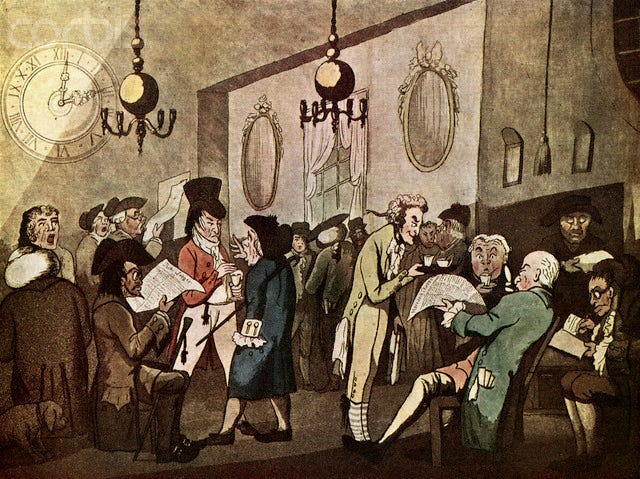
Those first issues of Tatler and Spectator were “subdivided according to the coffeehouse from which their intelligences were ostensibly gathered: political news from one establishment, literary talk from another, religion, fashions, and so on, from still others. In those days not only layabouts but the most vitally active, prolific members of society frequented coffeehouses. It was your social duty and pleasure to spend a portion of the day there; you knew you could expect to meet your friend at such-and-such an inn between certain given hours.” Lopate marvels—and here the pang of lockdown felt especially graphic—“How few of us have the opportunity to see our good friends daily!” And, he adds, our “enemies, rivals, and indifferent acquaintances,” as well.
Famously, Lopate is constitutionally unable to remain happy with himself; though I guess it’s more accurate to say that he’s most comfortable with his own ambivalence. His essays are shot through with skepticism and bolts of self-interrogation, which has led some readers to assume that Lopate is a grouch (and some critics, too; the New York Times review of Against Joie De Vivre was titled “An All-Out Assault On Fun”). I’ve never felt this way. Lopate is simply, complexly, human, leavening whatever pleasures and joy he experiences with the very realistic, sobering notion that this too shall pass, that the native state of the human is some blend of frisson and doubt. He laments: “But even when I try to dawdle [in a coffeehouse], with the assistance of a book or newspaper, my impatience forces me to get up after an hour and ten minutes at most.”
Lopate ends “A Passion For Waiting” with a balanced take on his sensibility, at once nostalgic for a time he never experienced and accepting of his own cynicism, recognizing with a sigh that “intellectual camaraderie and self-forgetful cooperation” probably constitute the “high-water mark” in his romanticizing of coffeehouses. “But having said so may idealized things about them, I have to admit that I would probably have been just as uncomfortable hanging around in them.” For one thing, he admittedly lacks “the Sitzfleisch, the sitting power.”
It would also be difficult for me, knowing my competitive nature, to spectate in loud brilliant groups, waiting to insert an occasional bon mot of my own through the fumes of conversation. Even if the Algonquin circle were to be revived tomorrow, with a chair for me, and if the talk were particularly sophisticated and bitchy, l would probably feel too threatened to stick around for long. I suspect I have more interest in regretting these roundtables of intellect as something the contemporary world has deprived me of, than in actually joining one if given the chance.
“I feel so identified with New York. I can’t figure out where I end and New York starts.”
So remarked Lopate to Melissa Giannini in 2012. Asked if his preoccupation with writing about New York City is of his own choosing or what people expect from him, Lopate replied, “It’s definitely partly of my own choosing. I think of myself as a writer, as a New Yorker, a Jew, and as an American, probably American fourth [laughs]. But my country is New York, and I have no apologetic feelings for loving cities. That is, I don’t have any of that anti-urban bias. And even when people say, as they often do now, ‘Oh, it’s not the same New York’—they seem to feel that some fatal poison has entered the bloodstream—I just don’t see it, because I was born here, I grew up here, and I’ve always seen it change.” He added, “I’ve always seen it destroy and rebuild.”
My dad was born and raised in Brooklyn, in the Greenpoint neighborhood; he eventually left the city, but his two brothers, my Uncles Tony and John, stayed behind. All three Bonomo’s are gone now, alas. When I was young, my family—all eight of us—would occasionally load up the station wagon and drive from Maryland to Brooklyn and Queens, to visit my uncles and aunts and my cousins, many of whom at the time looked (and acted) as if they were extras in Saturday Night Fever. I recall thrilling, slightly scarifying moments in the dark, noisy Lincoln Tunnel or cruising across the understatedly pretty Verrazzano-Narrows Bridge (depending through what congested entry point my aggrieved dad chose to steer our boat of a car), long, multi-course, home-cooked Italian dinners in my uncles’ small homes and loud, endless conversations, and siting on a stoop in Queens with my cousin John as he pointed out the various, bold demarcations dividing the neighborhood’s ethnic communities. (As an eleven or twelve year-old, he used words more crude than mine here.) I relished those trips, which were unfortunately rare. They implanted in my DNA a deep, lifelong love for New York City.
Along with the many visits that I’ve made back to the city in the following decades, and through countless books and movies and songs, I’ve managed to stoke a proxy love for New York. (While writing and researching Sweat: The Story of the Fleshtones, America’s Garage Band, I lived in Brooklyn for a month for consecutive summers, the closest I’ll get to residing in the city, barring that mega-million dollar lottery win.) And I’ve also lived vicariously through Lopate, a writer who’s felt the pull of the city his entire life. “When I was [living and teaching] in Houston, I was mostly writing about New York,” he admitted to Giannini. “New York had become subject matter, this paradox of alienation and community. You’re alone in a crowd. And yet there is a certain gregariousness that will pull you out of yourself. One reason I’ve never gone, except once in my life, to an artist community in the beautiful countryside is that I like to write in my house, and then I go out onto the street and I see anonymous strangers and that cheers me up.”
Reading Lopate always cheers me up. Two of my favorite of his New York pieces, from among so many, are different in sizes. One’s an essay, “Reflections On Subletting” also from Against Joie de Vivre, and one’s a book, Waterfront: A Journey Around Manhattan, published in 2004. “Reflections On Subletting” is vintage Lopate, a love story about reentering New York City as a visitor eager for a month’s or longer stay, poised at that sweet spot between the thrill of being back home and the melancholy uncanniness of a favorite son’s outsiderness. His details about his various sublets are dryly hilarious, moving between describing comfort and awkwardness, his writer’s eye and sensibility charged by the intimate nearness of a stranger’s many things colliding with his own habits and predilections. (The passage about his first heady nights back in town, charged and on the prowl for old friends and older restaurants, is particularly wonderful.)
“Each time I sublet, I land on a new box on the city’s Monopoly board,” he writes. “My lodgings have gravitated from the Upper West Side to Tribeca to Stuyvesant Town to Chelsea to Herald Square to West Village to Soho to the Upper Fast Side. I have learned Sunday moods, dry cleaners, supermarkets, greasy spoons, slants of light, and vest-pocket parks of each. Streets I had only passed through as a visitor before, on my way to a restaurant or movie, have become, however briefly, my home turf.” Lopate tries to convince himself that this “vagabondage” would make him into “a more complete New Yorker,” as he was experiencing the city better than when he was a resident. “On the other hand, these relocations have left me uncentered, with no firm attachment or loyalty to any one section of town. I feel like an adolescent shifting from youth hostel to crash pad at a time when I should be settling into the householding wisdom of middle age. Maybe this subletting binge is my last-ditch attempt to forestall middle age.” Elsewhere in the essay, he writes: “I am homesick precisely because I have come home, but not to any house of mine.”
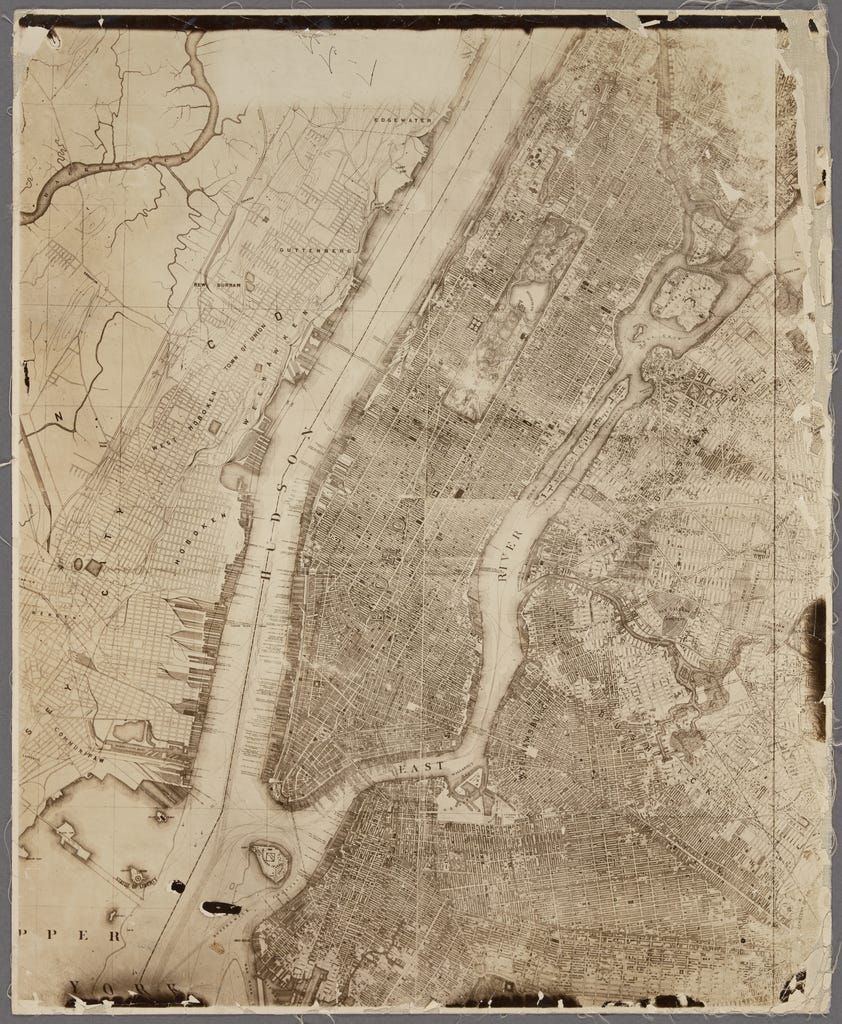
Waterfront is a tour de force, under appreciated, I feel, especially among New York books. Across more than four hundred pages, Lopate narrates the months he spent in the late 1990s and early 2000s walking around the perimeter of the island of Manhattan, sometimes in civic groups, sometimes with pals, often on his own. He blends his personal experiences navigating the island’s often inhospitable (and occasionally unreachable) shorelines with scholarly (though never dry) chapters on the waterfront’s history, its origins and its centuries of on-again, off-again development and the many political squabbles along the way, its lively geography, its appearance and treatment in films and books, and its celebrated writers, as well as the city’s shifting attitudes and policies that have encouraged (or sometimes discouraged) its residents from heading to the shore.
The though line in Waterfront is Lopate’s continuing astonishment at Manhattan as an island. He marvels both at the varied architecture along its shores and that shore’s fascinating aquatic history; he’s struck by both the meditative quiet of (some of the) stretches of the water’s edge and by the vibrant, heedless, water-ignoring street life nearby. A quirky, immersive, highly personal book of urban history, Waterfront is also a sublime entry in the flâneur tradition of literature. Highly recommended if you dig walking through, and alongside, New York City’s history.
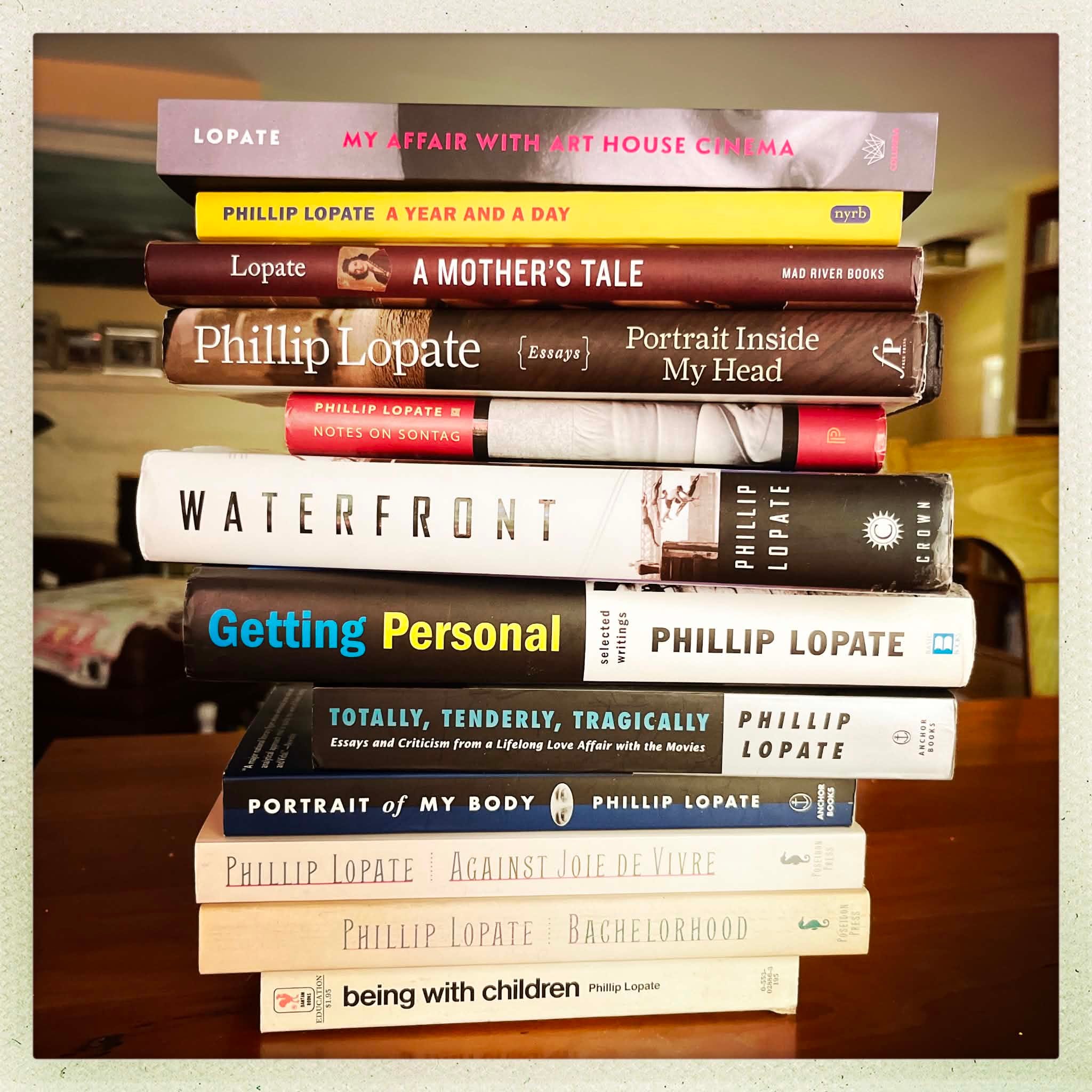
I’m a self-taught essayist thanks to Phillip Lopate. After I moved away from writing poems to writing prose thirty years ago, Lopate’s books, and his essential Art of the Personal Essay anthology, which I used in my creative nonfiction workshops for years, led the way. Lopate retired a couple of years ago after decades of teaching, and I’m heartened, though not at all surprised, to hear that he’s planing on hunkering down in Brooklyn to keep writing, filtering the small and large disappointments and joys of being alive through his native skepticism and stoicism.
You might also dig:
Family

I've just finished Phillip Lopate's A Mother's Tale, and it's a doozy, a deeply weird but engrossing hybrid of a book wherein Lopate disentombs taped interviews he'd conducted with his mother, Frances, when she was sixty-six and he was forty-one. For personal and psychological reasons Lopate ignored the tapes for more than thirty years—he'd stuck them i…
Let's take a walk on Avenue A

The Fleshtones have been banging around for nearly half a century now. A longtime New York-based band, these days only one member, frontman Peter Zaremba, lives in New York City (Brooklyn). Drummer Bill Milhizer and bass player Ken Fox decamped for upstate New York in the mid-2000s, and co-founder and guitarist
The life of 5am

In his remarkable new book New York Bars at Dawn, photographer Daniel Root documents a world that’s somewhere between poles: dark and light, barren and peopled, closed and open. The book is a graphic reminder that the cliché of a sleepless New York originates, as all clichés do, in a startling truth. Even dozing, these bars are awake to colorful light a…
Edward Lloyd's Coffee house, London, by William Holland (1789) via Picryl and Creative Commons
General map of the city of New York, Boroughs of Manhattan, Brooklyn, Bronx, Queens, and Richmond ; designed and prepared by Louis A. Risse via New York Public Library and Creative Commons
I've yet to read any of Lopate's books, and regret this. Thanks for your words about Waterfront — your descriptions brought back many memories of my time in NYC in my mid 30s (grad school, then work). When I moved away for the second and last time, in '98, I read Kathleen Norris's edited collection Leaving New York ('95), which features essays by writers (Capote, Morrison, Didion, etc.) who lived in and then moved away from the city. Waterfront sounds like just the right followup.
https://tonofworms.wordpress.com/2012/05/06/leaving-new-york-writers-look-back-edited-by-kathleen-norris/
Cheers, and enjoy your retirement!