
Slipping away
More than forty tears after its release, Dave Edmunds's Information remains a curio

Weather ignores borders—rain in northern Illinois is likely falling in southern Wisconsin, too—just as popular music leaks through the boundaries that separate decades. An arbitrary gathering of years, a decade implies that a Zeitgeist emerges with calendar regularity, when most of what we associate with a given ten-year span occurs at a later perspective. When I first heard Nirvana blasting from a rickety front porch in Athens, Ohio, my first thought wasn’t, This is an epochal Nineties moment, it was, Holy fuck.
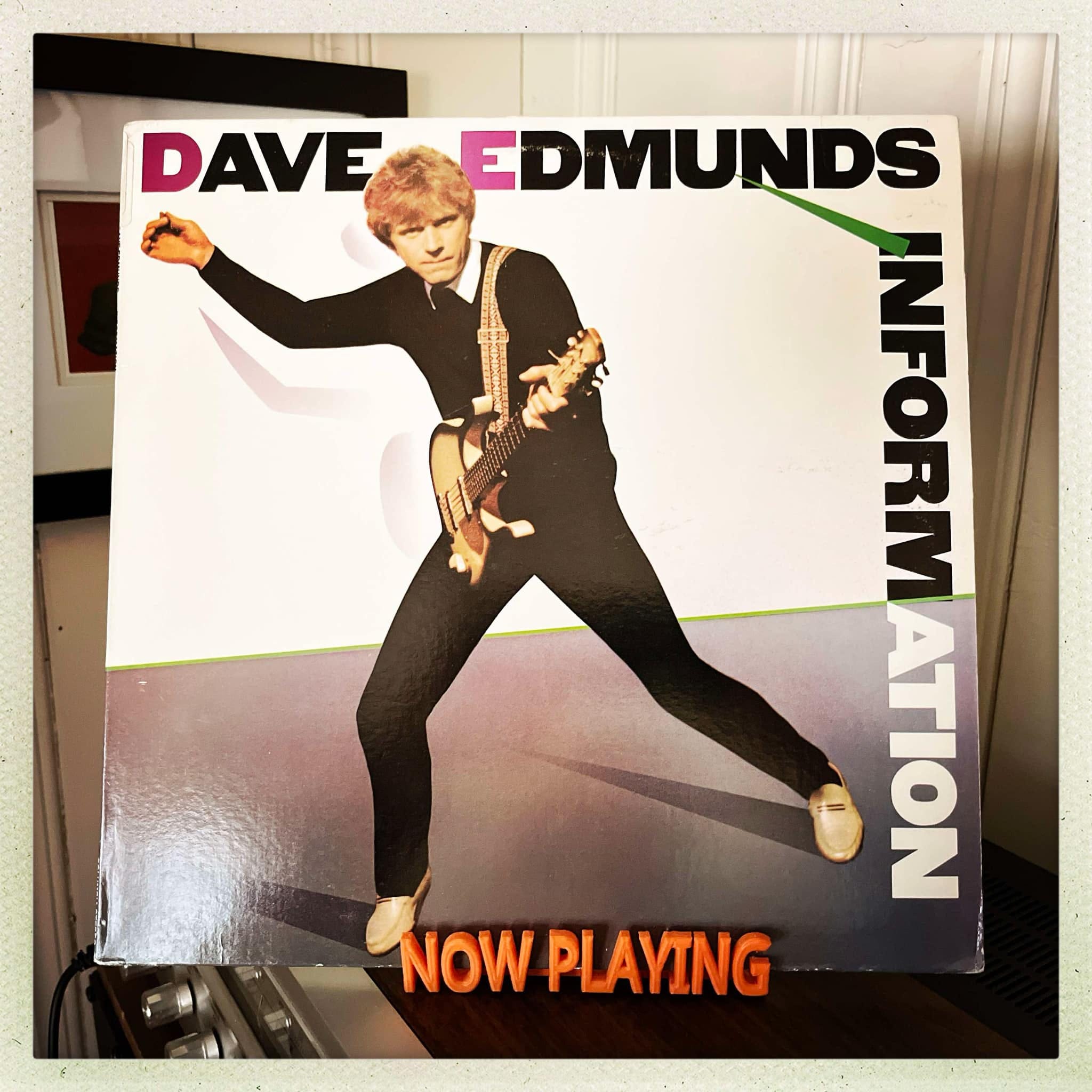
Yet I feel confident arguing that the 1980s actually began in April 1983 when Dave Edmunds released his eighth solo album Information. His previous record, D.E. 7th (1982), had been his first following the fiery implosion of Rockpile, Edmunds’s terrific on again/off again pub band with Nick Lowe, Billy Bremner, and Terry Williams, and featured a sublime version of Bruce Springsteen’s “From Small Things (Big Things One Day Come).” The Boss connection and a big market push helped D.E. 7th reach number 46 on the Billboard 200 and number 60 on the U.K. album charts. Edmunds—and certainly his record label, Columbia—were hungry for more.
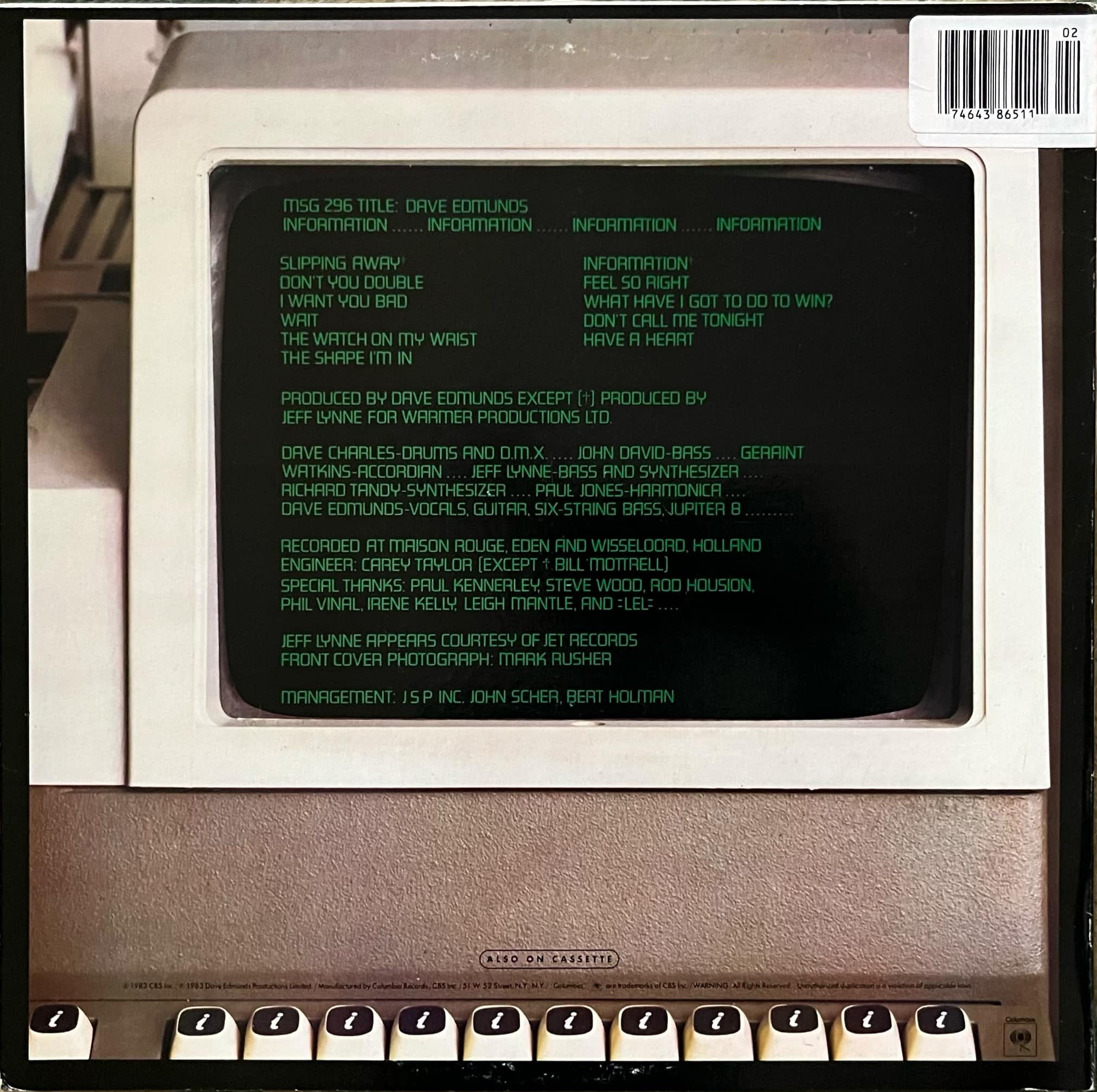
Edmunds had long been a fan of Jeff Lynne and the songs he meticulously crafted for his band Electric Light Orchestra. “I just wanted to see what it would be like to do an album with someone I admired and who does great records,”’ Edmunds said to an AP reporter in 1983. “I just called Jeff up and he was enthusiastic about it.” Edmunds gathered a new core band—John David on bass, Dave Charles on drums, and Geraint Watkins on keyboards and accordion—and recorded Information among three studios. Lynne produced two songs, the title track and “Slipping Away,” but his sonic fingerprints were everywhere on the album. “It was great fun,” Edmunds remarked of the sessions, acknowledging that from the two tracks that Lynne produced, “a lot of his style rubbed off on me and it shows on the other tracks I produced myself on the album.”
The result is a curiosity, an of-the-era attempt to forge (or to force) Edmunds’s loose, rootsy style with high-gloss digital production, a studio marriage essentially of the 1950s and the 1980s, of blues-based rock and roll and synthesizers, the latter played on the album by ELO’s Richard Tandy and Lynne, who also added bass. Certainly such sonic leaps had been attempted before, but to my ears rarely did the gap between an artist and their producer’s styles yawn quite so glaringly as it does on Information. In interviews from the period, Edmunds acknowledged the trepidation that he felt prior to the sessions. “I certainly had never worked with a (electronic keyboard) synthesizer or drum machine before,” he said to the AP. “I even stayed away from keyboards on stage,” adding with a laugh, “That wasn’t me.”
Some of these remarks reveal Edmunds to have been a bit uncomfortable. (Though I may be unfairly judging them with hindsight.) “The electronics give it a larger sound, an updating of what I’ve always been doing,” he insisted, before adding, “I’m also homing in on a more unified sound. My first albums were bits of everything stuck together, which was fun. But it always bothered me that it was no one particular style that someone could relate to. Now it seems to be settling down.” In the event, the album’s first single, “Slipping Away,” gave Edmunds his first Top-40 hit since his grooving cover of Smiley Lewis’s “I Hear You Knocking” hit number four back in 1970. Information reached number 51 on the Billboard 200 album charts and number 92 in the U.K..
So, after a fashion, it worked. Yet more than four decades later, the album remains a curio to me, a jacket that just doesn’t fit right. Edmunds sings terrifically throughout, and his guitar playing, when not muted, bites and moves with his inimitable style. But his normally ace band plays for the most part bloodlessly, as if tethered to a collective metronome—which is a shame, because the musicians swung nice and loosely on D.E. 7th, and would continue to jell for years; dig Edmunds and the band’s fun, lively versions of “The Wanderer” and “Paralyzed” on the 1987 live album I Hear You Rockin’.
But Information is neither particularly fun nor particularly lively; it’s more chalkboard theory than lived-in practice. Some of the material works well despite the antiseptic surroundings. John David’s “Have a Heart” and “The Shape I’m In” are solid tunes that are played well, unaffected by the production. (Geraint Watkins’s accordion on “The Shape I’m In” adds some much needed warmth to things.) Covers of John David “Moon” Martin’s “Don’t You Double” and NRBQ’s “I Want You Bad,” both killer tunes in their own right, work well enough, as does Kennerley’s “Feel So Right,” but the arrangements leave little room for frayed edges, surprises, or the recklessness that playfully threatens Edmunds’s greatest recordings, those done mostly with Rockpile: “Crawling From The Wreckage,” “Down Down Down,” “Trouble Boys,” “I Knew The Bride,” “A.1. On The Juke Box,” “Here Comes The Weekend,” “Never Been In Love,” “From Small Things (Big Things One Day Come),” “If Sugar Was As Sweet As You,” et al, boozy, loose-limbed, brash performances. They’d be dangerous if they weren’t so genially attacked. The sound and the mood of a pub at that sweet spot between a few and a few too many.
On Information, the airless production seals off whimsy and roughness, so that the record has to resort to in-studio affectations. In “What Have I Got to Do to Win?”, period-specific synth noodling cloyingly interferes with Edmunds’s guitar playing, reminding me of the low-rent experiments I’d conduct down in the basement when I was a kid, pouring random chemicals together from my Junior Chemistry Set to see what might happen—and nothing usually did. I can say that under Lynne’s watchful eye, Edmunds nearly produces something arresting, something unique, anyway: Kennerley’s “The Watch On My Wrist” is a bizarre, genre-skipping tune that sounds like an attempt at an interstellar country/honky tonk weeper. Edmunds’s winning voice is filtered through a vocoder, for the first and last time in his career.
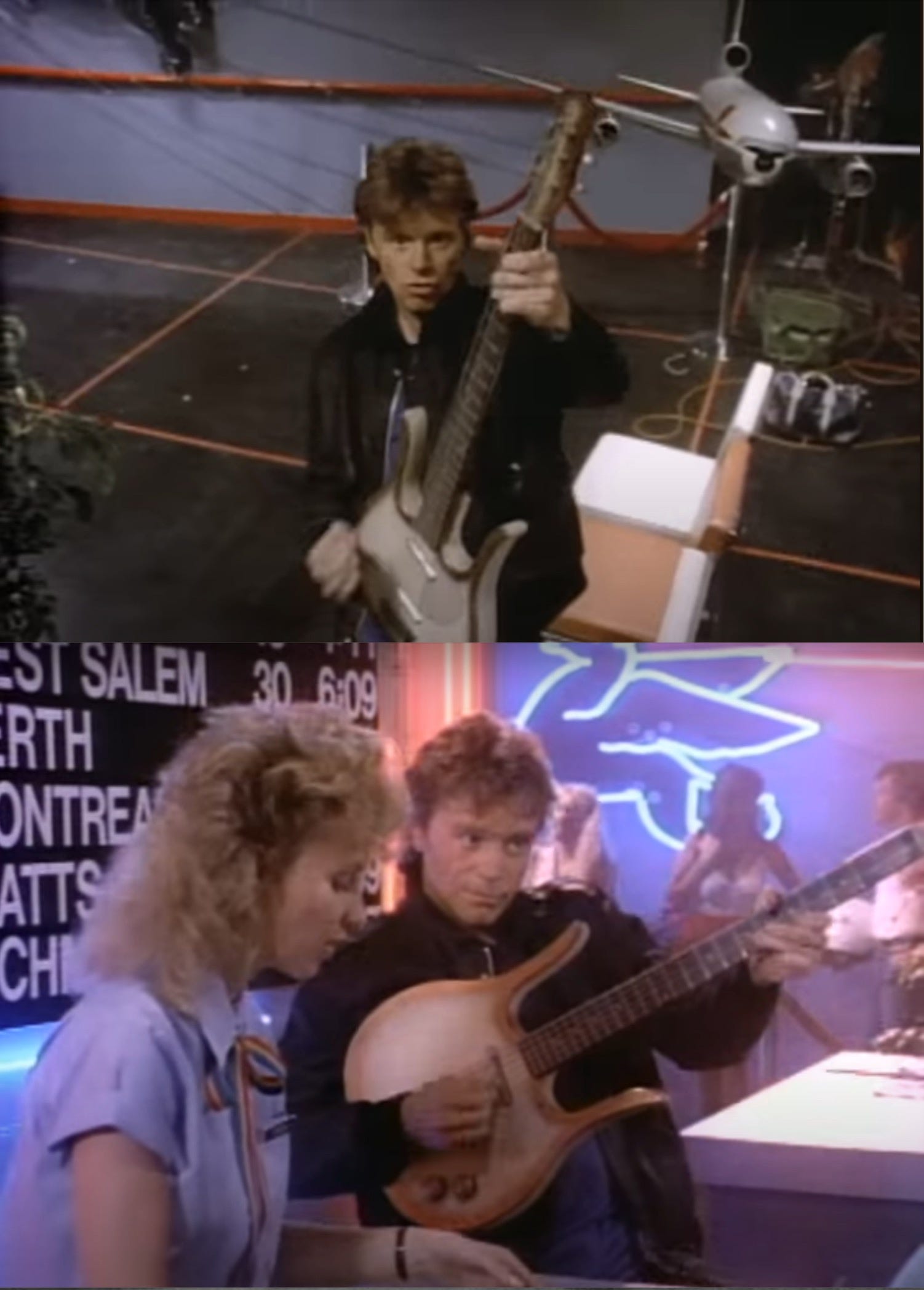
Edmunds and Columbia Records duly produced two videos to support Information, each appealingly in the mid-1980s MTV style, and so each a relic of that era. They’re also the two strongest songs off of the album.
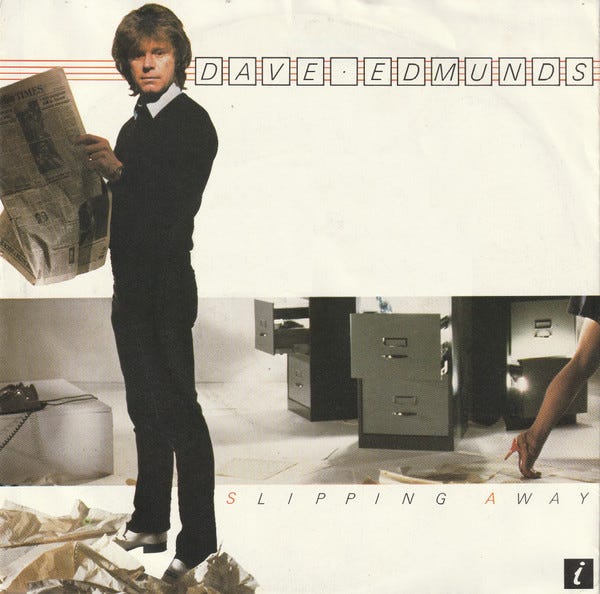
“Slipping Away” managed to make it on to the high rotation schedule at MTV, if briefly, and features the kind of half-baked-narrative-meets-surrealism look that every videographer needed to master in the 1980s, often leaving the artist or band scratching their heads at the results. The video’s “story” unspools on a few threads. In one, a glum-looking Edmunds and his pretty date drive an expensive looking vehicle while towing a vintage stock car behind them; in the second, the woman, her face now smeared with sweat and motor oil, her hair a mess, labors resentfully under said stock car in a garage where Edmunds and his band mime to the song; footage of vintage stock car races is edited throughout. At the end of the video, Edmunds and his date, their car stalled, are stuck hopelessly by the side of the road, where the woman sexily slips off her mechanic’s garb and loosens her hair to strut off into the twinkling night. It all makes sense, trust me.
The video for “Information” is a lot more fun, in part because Edmunds seems to be having a lot more fun with it. A great song, written by Edmunds with Mark Radice, “Information”’s sprinting pace is reflected in the amusing mania of the video, which drops Edmunds in an airport, duly festooned with moody, Miami Vice-style pastel tube-lighting, where he’s frantic to find his girl before she boards her plane. He flirtatiously serenades a ticket agent. He consults a palm reader. He smashes open dozens of fortune cookies. He plays guitar and mimes the song while standing in front of a urinal. Standard stuff. But the song’s great. And Edmunds is clearly having a good time, stalking the airport wearing a black leather jacket, bright eyes, and an impish smile at the silliness of the goings-on. Spoiler alert: he gets the girl at the end (I think).
Anyway, both videos are worth watching if only to see Edmunds playing his kick-ass Danelectro Longhorn guitar.
The Jeff Lynne-led data mining continued, to diminishing commercial returns, with Edmunds’s follow-up, 1984’s Riff Raff. It’s a pretty dull and dreary affair, though Holland-Dozier-Holland’s “Something About You” is too great a song to mess up, and I’ve always liked Lynne’s own “S.O.S.”. Old mate Terry Williams from Rockpile is behind the drum kit for the album, but don’t get excited: sadly his rough and tumble fills are nowhere to be found.
“I feel like I’m a fan who just happens to make records as well,” Edmunds explained to an AP reporter a year after the release of Riff Raff, the last album with which he’d collaborate with Lynne. “I reflect through my records just what kind of music I’m a fan of.” Edmunds shrugged his shoulders at fans who were surprised that he’d teamed up with Lynne, and admitted that he was, in fact, a fan of synthesizers and drum machines, though misuse of the technology “does get up my nose a bit.” “Because it’s so obvious,” he explained. “It’s obvious it’s a drum machine and these synthesizers being triggered and it sounds relentlessly in time. It’s so in time it starts getting annoying, I think it's wearing a bit thin with a lot of people.” He added, not entirely convincingly, “When Jeff Lynne does it, it seems to be OK. But if you’re not subtle, then it just gets bloody irritating.” Edmunds’s next two studio albums were Closer To The Flame (1989) and Plugged In (1994), both conscious attempt to get back to his rock roots. He’s since been enjoying semi-retirement in his native Wales, issuing variations of his recordings and occasionally hitting the stage when the mood strikes him.
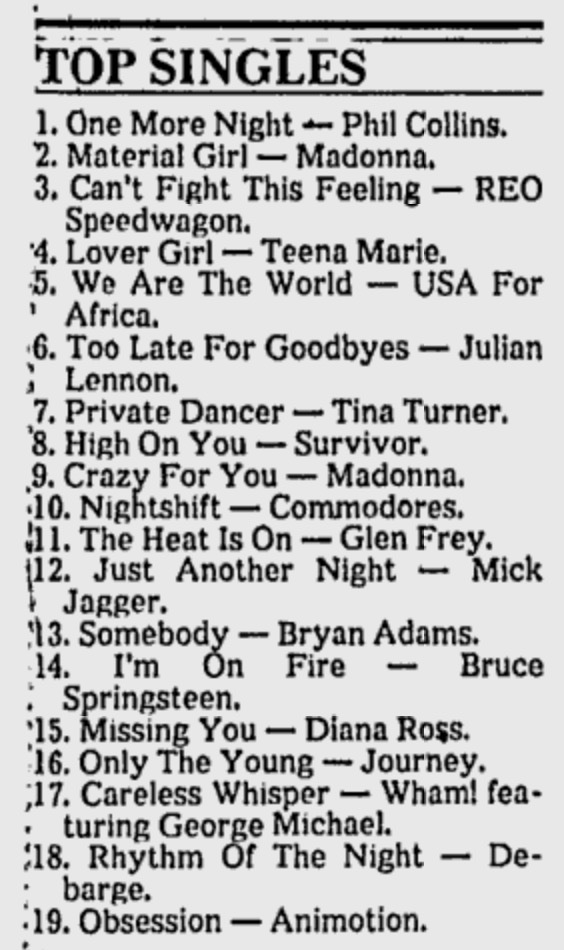
For his part, after working with Edmunds, Lynne produced an ELO album (1986’s Balance of Power) before teaming up with George Harrison in 1987 for Harrison’s Cloud Nine, a highly successful album led by the hit singles “Got My Mind Set On You” and “When We Was Fab.” A small item tucked below that 1985 article (“Edmunds creates with rock ‘n’ roll greats”) is a list of the “top singles” for March of that year. No official source is cited, yet the litany is persuasive enough of the considerable odds stacked against Edmunds in his attempt to scale the commercial mountain. Phil Collins. Madonna. REO Speedwagon. Teena Marie. Survivor. Wham!. Debarge. Animotion. Entrée into that glittery crowd was a tall order indeed for a dyed-in-the-wool Chuck Berry worshipper and guitar playing traditionalist.
See also:
"Sincerely, your beloved son...."

Chuck Berry released "Dear Dad" on March 15, 1965, his 38th single for Chess. It cracked the Top 100, idling at the 95 spot for a month. It's always been one of my favorite Berry tunes, a post-peak gem that tells a witty story with a great punch line while rocking slyly. Berry

"Party Party"

I've never understood why Elvis Costello—an artist intent on re-releasing his entire back catalogue—has turned his back on "Party Party," a tune that he and the Attractions donated to the soundtrack to Party Party, a 1983 British film. "Party Party" has been omitted from Costello's cannon on his
Though this is way, way down on my list of favorite DE LPs for all the reasons you mention, I have to say that “Slipping Away” and (especially) “Information” sounded great on the radio in the summer of 1983, especially between hits by the likes of Loverboy and Men Without Hats.
Jeff Lynne has ruined more records for great artists than anyone I can think of. I will admit that several of those awful records have been commercially successful, but I can never understand why. His production is immediately recognizable and instantly grating. I’ve never been able to figure out why the ELO records are so good and everything else he touches is leaden garbage. It’s almost as if he is trying to wreck everyone else’s stuff…