
"This Miles Davis thing"
Or, how Lester Bangs learned to love On the Corner

Lester Bangs famously dismissed the MC5’s debut Kick Out the Jams as “ridiculous, overbearing, pretentious,” the band as an overrated machine done in by its own hype. A couple of years later, Bangs equally famously recanted. “But then, it was the first review I ever had published,” he wrote in 1971 in “James Taylor Marked for Death” in Who Put The Bomp, “and even if more death threats came in after that review than any other save Jann Wenner’s [review of Cream’s] Wheels of Fire…(and most of them from sweet home Detroit), I can see why people privileged enough to be part of the apocalyptic birth of the Five would be enraged. And to compound the irony, Kick Out the Jams has been my favorite album or at least one of the two or three most played for about three months now.” Bangs went on to describe the MC5’s second album Back in the USA as “an underrated classic.”
All’s fair in Hot Takes and Reconsiderations. One of the reasons I don’t think that I’d be a particularly useful music journalist is that I so often evolve in my feelings and arguments about an album, a song, or an artist, which, though hardly unique, makes for uncomfortably wide vistas between what are equally sincere takes. I find it risky—humbling, I guess, on a good day—that what I can so confidently think and feel one day might over time be supplanted by a measured, even dare I say, a smarter point of view. I sometimes feel that every piece I write should remain eternally open-ended, a live document at “the conclusion” of which I ought to refrain from pressing Save. (Has Internet and social media writing, which one can operate as a kind of 24/7 mea culpa if one wishes, largely erased this issue?) “If my mind could gain a firm footing, I would not make essays, I would make decisions,” Michel de Montaigne wrote more than four hundred years ago. An age old dilemma.
A few years after coming around on the MC5, Bangs about faced yet again. By the mid 1970s, Miles Davis was part artist, part legend, and nearly all myth, poised at semi-retirement, beset with addictions, a tempestuous personal life, and agonizing health issues. Having startled critics and jazz fans and rock fans alike with the unprecedented Bitches Brew (1970), Davis was busily riding out a series of recording sessions from earlier in the decade, releasing the studio albums Jack Johnson (1971), On the Corner (1972), Big Fun, and Get Up with It ( both 1974), as well as the live/studio Live-Evil (1971) and the concert recordings In Concert (1973), Agharta (1975), and Pangaea (1976). Deep in his fertile, contentious electro-funk years, Davis, conspiring in the studio with, and in no small part relying on, genius producer Teo Macero, was intuitively reducing his bands’ ensemble playing to elemental, hypnotic jams, squeezing out squiggly, spare melodies—George Grella Jr., in his book on Bitches Brew, describes this as Davis “speaking in aphorisms”—against drone-like, percussion-heavy soundscapes. Davis himself often drifts into the dense sonic background, one of many alert yet distracted-sounding noises rising and falling while competing with other noise.
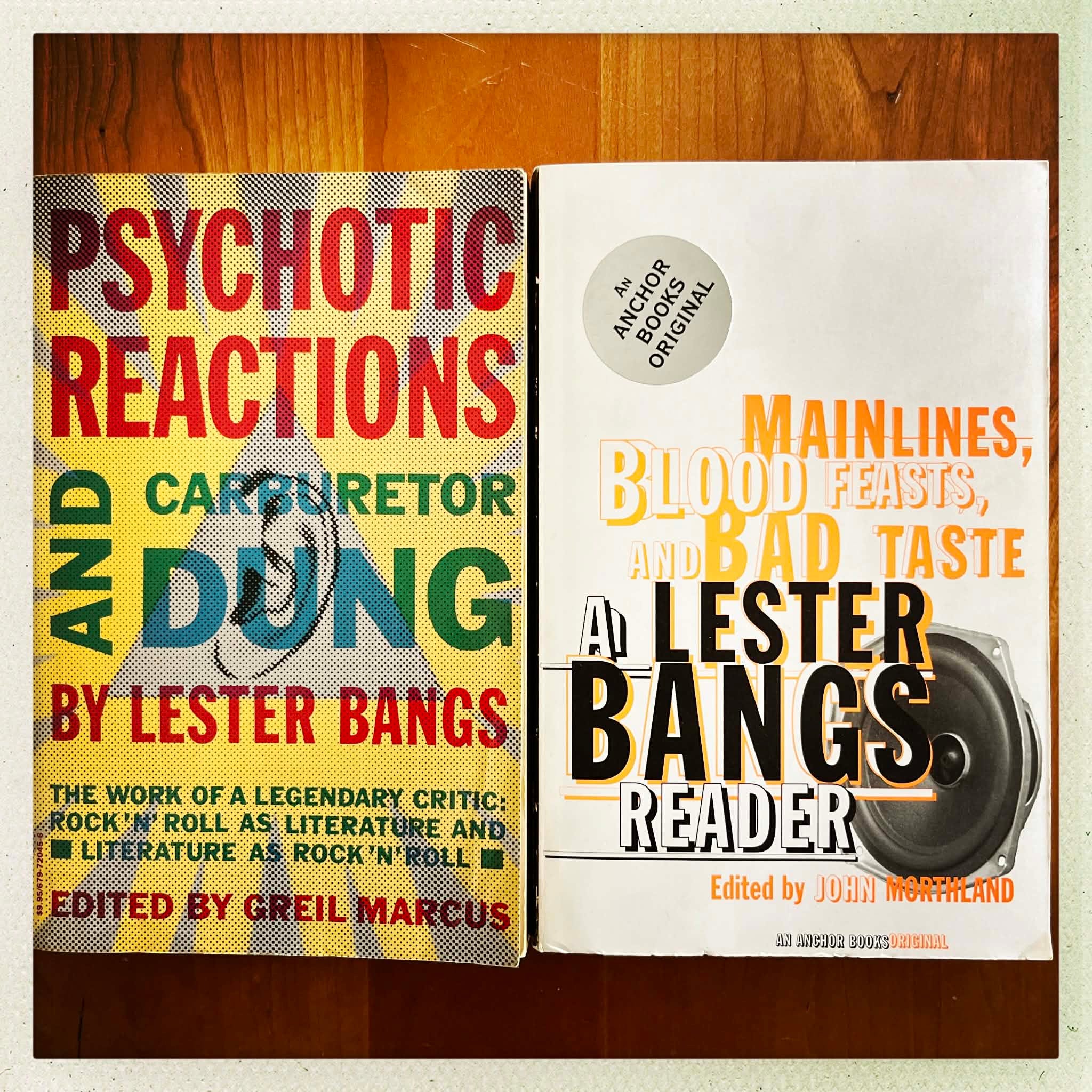
Bangs was a lifelong fan of Davis’s, and by the middle of the 1970s, he was a stumped one, too. “I have been wrestling with this Miles Davis thing for what has amounted to years now,” he confessed in June 1976 in “Kind of Grim: Unravelling the Miles Perplex” for Phonograph Record. (The piece was reprinted seven years later in New Musical Express, and included in John Morthland’s Mainlines, Blood Feats, and Bad Taste: A Lester Bangs Reader in 2002.) The essential, knotty problem for Bangs: as critics “try to figure out whether the relative nonimpact of all this shit boils down to us or him,” they also face the difficulty of “deciding whether albums like Miles Davis in Concert were difficult, dense masterworks or plain old dogshit,” adding, “it wasn’t even as simple as the fact that Miles is a figure traditionally deemed above criticism, but rather that nobody wants to be caught sitting on yesterday’s curb wacking their doodle to old blowing sessions when Miles is sculpting new thruways and monorails.”
That’s classic Lester, and a classic problem: is it the artist or is it me? Bangs argued in ‘76 that On the Corner was “the absolute worst album this man ever put out. On this experiment in percussion and electronics, what little actual trumpet you could pick out of the buzz-whiz and chockablocka was so distorted as to be almost beyond recognition. And this from the man who made a good deal of his rep on the devastating, transcendent depths of pure human emotion he could find in his soul and axe. It seemed almost to amount to a form of suicide, or at least an artistically perverse act of the highest order.”
Bangs was no stranger to free jazz—he boasted that he “used to listen to Coltrane’s Ascension and Albert Ayler’s Spiritual Unity while eating breakfast”—yet he felt stiff-armed by Davis’s Stockhausen- and Buckmaster-inspired experiments, not because he didn’t understand or identify with Davis’s brave ambitions, but because Davis had left something essential behind in his journeying. Whenever Bangs was down and depressed, which was often, suffering a “severity that could reach by degrees from my consciousness to my heart to my soul; because I was sweeping some deep latent anguish under the emotional carpet, or not confronting myself on some primal level…Miles cut through to that level.” Bangs was obsessed “simply because he is Miles, one of the greatest musicians who ever lived, and when a giant gets cancer of the soul you have to weep or at least ask for a medical inquiry.”
What bothered Bangs about the music from Davis’s early- and mid-‘70s period was that “once you got past the predictability and disappointment and analyzed the actual content of the music, it took Miles past his traditional (and traditionally heart-wrenching) penchant for sustained moods of deep sadness into a new area redolent more of a by turns muzzy and metallic unhappiness.” He waggishly added that Davis should have called one of the albums from this era Kind of Grim (after Davis’s landmark 1959 album Kind of Blue), before landing on a cuttingly astute observation, the kind of pivot-to-seriousness that Bangs perfected: “Mere unhappiness, elaborated at whatever electro-technocratic prolixity, is not nearly the same as anguish.”
Four months before his death in April 1982, Bangs published “Miles Davis: Music for the Living Dead” in Music and Sound Output (also included in Mainlines, Blood Feats, and Bad Taste.) “Okay!” he barks rhetorically at Miles in his opening, “It’s hip for every no-ears trendy in the world to like On the Corner now! Satisfied?” Chastened, Bangs was now including himself in that group. “The truth is that the jazz of the Eighties, if there’s going to be any that matters, probably began in 1972 with On the Corner,” he acknowledged. “God knows few enough people had any use for it in the Seventies, including me, who had followed and loved everything Miles did from Birth of the Cool on out, and couldn’t even hear it, much less feel its cold flame and realize its intentions, for five years after it was released.”
What did half a decade do to Bangs’s head and ears? It’s hard to say, and harder to know. Even sensitive and dedicated listeners often have to catch up to a record, and Bangs was no exception. It appears that two things occurred: one, at the start of the 1980s, On the Corner suddenly was speaking clearly to Bangs as a kind of soundtrack to urban chaos, and two, as Bangs focused more on the people around him, the album began—or, more accurately, continued—to reflect certain unsavory qualities about those people. When Bangs wrote about music that he cared deeply about—the Velvets/Lou Reed, Van Morrison, Joni Mitchell, Patti Smith, the Clash, et al—he was chiefly writing about being a messy human being. On the Corner began to matter to Bangs in ways that it hadn’t on its release, because, back in ‘72, Bangs couldn’t get past his own deeply personal dissatisfactions that Davis wasn’t repeating the lyrical solos and passages that had moved Bangs so deeply, that had rescued him and had changed his life—his playing on Porgy and Bess, Kind of Blue, Sketches of Spain, In a Silent Way. Bangs took it personally.
In his ‘81 reassessment, he urged those who still struggled with On the Corner to “put it on cassette and listen to it while walking around downtown Detroit, New York’s 14th Street, or any really busy, crowded urban area. (Though interestingly enough I first really heard it when I was in Jamaica, where it was suddenly almost obscenely, frighteningly alive, and its sense of menace unmistakable.) As an old girlfriend said once when we drove through ghetto Detroit with it on the box, ‘I get it; this is an environment record’.” What Bangs first felt as bleak emotionlessness in On the Corner “turned out actually to be an alienation so extreme that we could only grow into it and the album as time caught up with us and we caught up with Miles.” And perhaps Bangs couldn’t yet acknowledge On the Corner’s targets, which were all around—and which quite possibly included—him.
So, an album that Bangs had panned as “the absolute worst [that] this man ever put out” began to mean something to him; those hitherto aimless studio jams and meandering, one-idea indulgences were suddenly consequential. “This music is about something,” he wrote, with that wonderful honesty of feeling that Bangs chased, even if it meant upon finding it that he’d been wrong about something. “What it is about is what we are becoming: post-human and, concomitantly, technology-obsessed. This is the poison whirring through the wiring of a supersociety which has become a cage, what Max Weber prophesied when he wrote before the First World War of a populace ‘embracing... mechanized petrifaction, embellishing a sort of convulsive self-importance.’” Bangs could’ve been writing presciently about the twenty-first century and its monumental turn of a collective, glazed eye toward bright screens and the curating of ever more shifting, quasi-authentic selves. He directed his readers to look around at the people around them who have become “the machines they worship, successfully post-human. Now go look in the mirror. Like what you see? Think you’re pretty cool, eh? Well, reflect on the fact that they all think the same thing when they look in their mirrors. And you look just as grotesque to them as they do to you.”
“Now go put on, say, Side Two of On the Corner. Feel more at home now?”
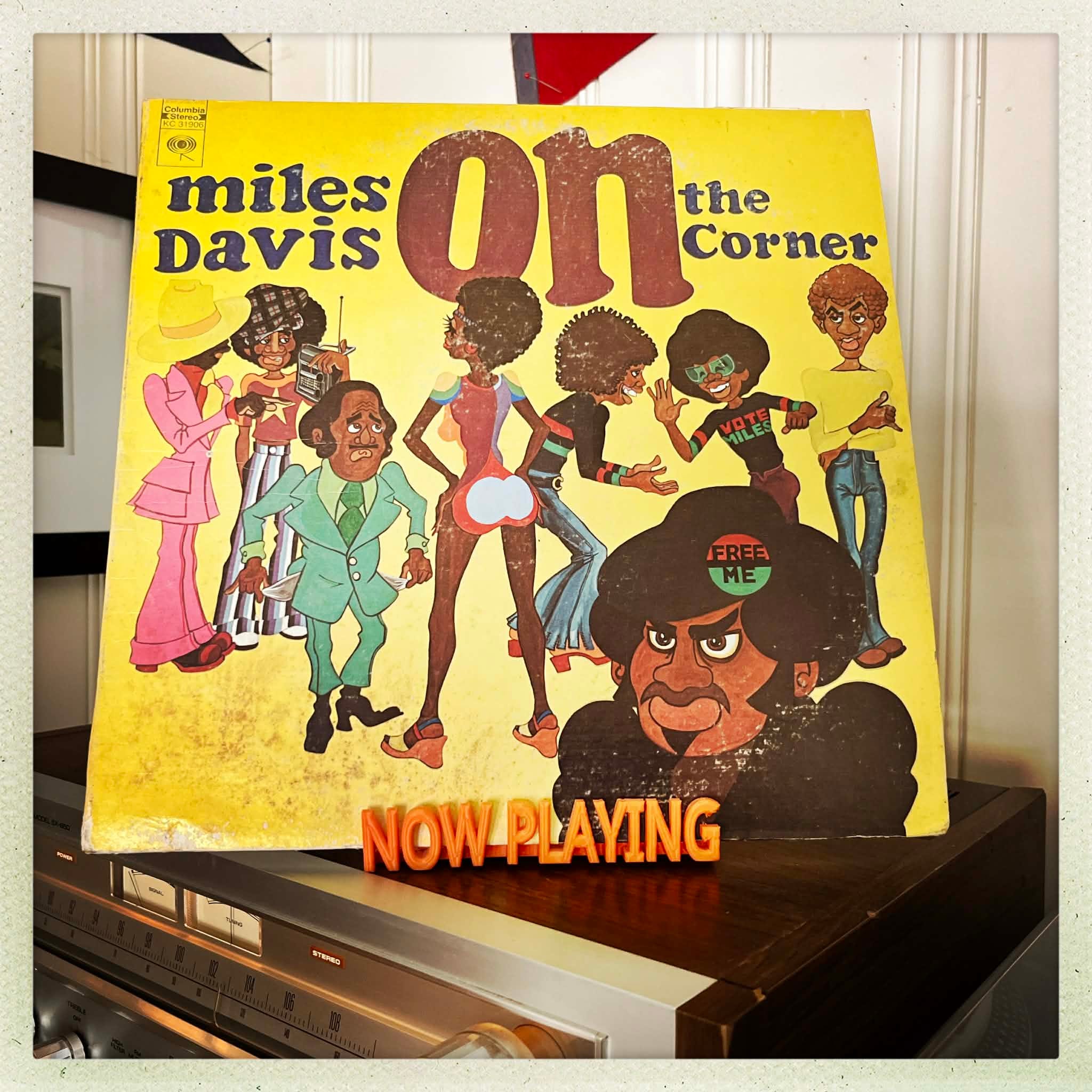
On the Corner was recorded among three sessions in June and July 1972 at Columbia 52nd Street studios, in Manhattan; after splicing, editing, and sequencing, the album was released in October. The first track is divided among the title composition (which lasts for two two minutes and fifty eight seconds), “New York Girl” (1:27), “Thinkin’ One Thing and Doin’ Another” (6:40), and “Vote for Miles” (8:49).
Here are some words that come to mind when I listen to On the Corner: metallic, shriek, agitated, nervous, uptight, funky, choppy, bold, industrial, cocksure, urgent, driving, pissed off, yearning, dreamy, unhappy/unsatisfied, hypnotic, spacey… All of which do about as much to evoke the remarkable performances on this album as describing the top of Mount Everest as “high.” The musicians are uncredited—Davis wanted their instruments to mesh, to grow faces of their own, without any discographical intrusion—which was controversial, yet in retrospect a brilliant (if probably unfair) gesture. How diminishing it is, or anyway how unhelpful, to know the names and the molecular makeup of the visible, infrared, ultraviolet wavelengths that comprise that burst of sunshine that blinds you at the end of a shitty gray day; at that moment, your ashen face and undernourished soul don’t particularly care about the science. You’re simply grateful.
That said, let’s get specific: Michael Henderson’s single notes and occasional runs on his bass anchor it all, slyly providing the bounce house for the other instruments to alight from, land on, and fly back up again. Percussion-heavy, a flat-out, funky groove, the opening track paradoxically roams as it jogs in place—and in this context, the brief move by drummers Billy Hart and Al Foster into four/four time about five and a half minutes feels like a hundred yard dash—digging the soundscape that it both distractedly and vividly creates. “Black Satin” (5:16), the song that most of the album’s listeners agree on, is prepared for by the tabla (played by Badal Roy) and electric sitars (Khalil Balakrishna and Collin Walcott) that emerge in final minutes of “Vote for Miles.” An “Eastern” flavored and then swiftly a very funky composition, “Black Satin” takes wing on excitable hand claps and shakers/bells played in syncopation, and, most vividly, on an urgent hook played by Davis on trumpet using a wah-wah pedal, a melodic passage that could’ve easily been exploited as a theme for a thriller or mystery flick. (In the event, the track was issued as a single by Colombia under the highly unfortunate name “Molester.”)
In many ways the album’s overriding theme, the “Black Satin” lick returns in the percussion-driven “Helen Butte” on the second side, a track that continues the fat groove of that side’s opener, “One and One.” I find myself whistling this “theme” throughout the album; it feels as if it’s in On the Corner’s DNA (if we must send the album to the lab). Keyboard jabs and runs, played variously by Chick Corea, Herbie Hancock, Harold Ivory Williams, Jr., Lonnie Liston Smith, and Cedric Lawson, add texture and color throughout; the elastic groove remains, the sitars return again in “Mr. Freedom X.” Davis and Macero’s ambitious audio environment arrives, pulsates, and vanishes over an hour, yet it’s never really gone, or ended, anymore than, during nightfall, the sun disappears. It’s just on the other side, always incandescent.
“The music was meant to be heard by young black people, but they just treated it like any other jazz album and advertised it that way, pushed it on the jazz radio stations.”
So Davis complained bitterly about his record label in Miles, his 1990 memoir written with Quincy Troupe. “Young black kids don’t listen to those stations; they listen to R & B stations and some rock stations. Columbia marketed it for them old-time jazz people who couldn’t get into what I was doing now in the first place. It was just a waste of time playing it for them; they wanted to hear my old music that I wasn’t playing anymore.” Davis added that when Herbie Hancock released his iconic Head Hunters album in 1973 “and it sold like hotcakes in the young black community, everybody at Columbia said. ‘Oh. So that’s what Miles was talking about!’ But that was too late for On the Corner, and watching the way Headhunters [sic] sold just pissed me off even more.”
Decades later, of course, On the Corner is highly valued by fans, critics, funk and hip-hop artists, DJs, and crate-diggers, some of whom, no doubt, underwent the same kind of reappraisal that Bangs did. In 2014, Stereogum placed On the Corner at the top spot of its ranking of Miles Davis’s studio albums, just above Kind of Blue. Davis’s own website makes a startlingly discerning observation about On the Corner: “One could call this album Metal Machine Miles.” Indeed, Davis and Macero’s discordant, hard-to-digest creation shared some textures—and a hell of a lot of attitude—with Lou Reed’s infamous 1975 double-album fuck you, a record and a moment in time that Bangs had a lot of fun hate-loving, or love-hating. Ah, if only Lester had engaged with Miles in sit-downs the ways Lester engaged with Lou! Think of the take-down/mea culpa, boisterous, brilliant/ludicrous hotel room interviews we might’ve gotten!
Alas, Bangs was stuck alone in his apartment, puzzling over On the Corner’s greatness and writing about it. Fascinatingly, the same metaphor makes an appearance in both of the pieces Bangs wrote. In 1981, having come around to an album that required that he take a second look outside at the forever altered mean streets, Bangs posed a rhetorical question: “Ever feel emotionally impacted?” (The answer that he’d receive from his readers was understood.) “Take the most expansive heart in the world and subject it to unknown force with almost unimaginable pressure, compress and crush it relentlessly until it is one small cold hard ball of anthracite black hate. Then watch it begin to turn in the void, spitting occasional needles of light. That’s what I hear in this music, that and the perception of being constantly surrounded by alien entities, insectival and reptilian, swarming all around you On the Corner.”
That startling metaphor was, in fact, a call back. “I have finally learned to think of Miles’ most recent music and what he has done to his art as taking a jewel,” Bangs had written five years earlier in “Kind of Grim,” “a perfectly faceted diamond as big as the earth shining brighter than ten thousand suns, suppose you took that jewel and with implacable, superhuman, malevolent hands crushed it in on itself, compressed by a force beyond comprehension until it was half its original size, black all over and a cold and unbreakable lump.” He added, “perhaps that is all that is left. But in a curious way that almost glows uniquely brighter in its own dark coldness; and that, that which is all that is left, is merely the universe.”
A pity that Bangs couldn’t go on for longer than he did agonizing and yet living for those loud, hard-fought journeys between dark and light, puzzlement and surprise.
You might also dig:
"Most of you won't like this"

On a bright, breezy morning recently, I put on Lou Reed’s Metal Machine Music, as you do. I’d tracked down a decently-priced vinyl copy of the infamous double album in good condition, and was eager to listen to the whole thing end-to-end, which I’d never done. Inspired by
Goin' wherever you take me

I was introduced to the Chi-Lites’ transcendent “Stoned Out of my Mind” by the Jam, who included a cover of the song on a double 7” of their final single “Beat Surrender,” released in the U.K. in November of 1982. The Jam had recorded it a month or so before at Marcus Studios, and I’ve learned only recently in Dennis Munday’s book
Time will go and you're free

The Kundalini Genie’s fourth album 1111 (sometimes stylized as 11:11), released in the difficult Spring of 2020, is a mind-bending soundscape journey into interior states propelled by loud, fuzzy guitars, mammoth, reverb-soaked drumming, and airy vocals in dreamy arrangements, the sound saturated and rich. Chords change as if moving lazily underwater, k…
“Davis, Miles—Tutu” by Lawren via Flickr
“Miles Davis 1971” by JPRoche via Wikipedia Commons
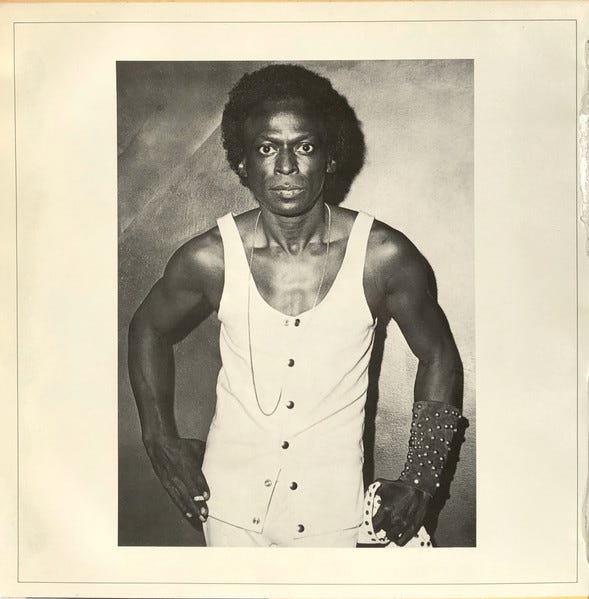
Photo of Davis from inner gatefold sleeve of On the Corner (Columbia, 1972) via Discogs
Fantastic piece. To paraphrase Dylan, [Lester Bangs] contained multitudes. . .
I think moving to New York in 1976 helped acclimate Lester's ears to "On the Corner." It was New York street music, elevated to Miles level--what he heard was not what you and I heard--in the city's roughest decade. Also, it's my answer to the question: "What record sounds just like its cover?" "On the Corner" does, no doubt.