
Love in songs
I look back at Paul McCartney's extraordinary solo career and write about my favorite songs from each decade

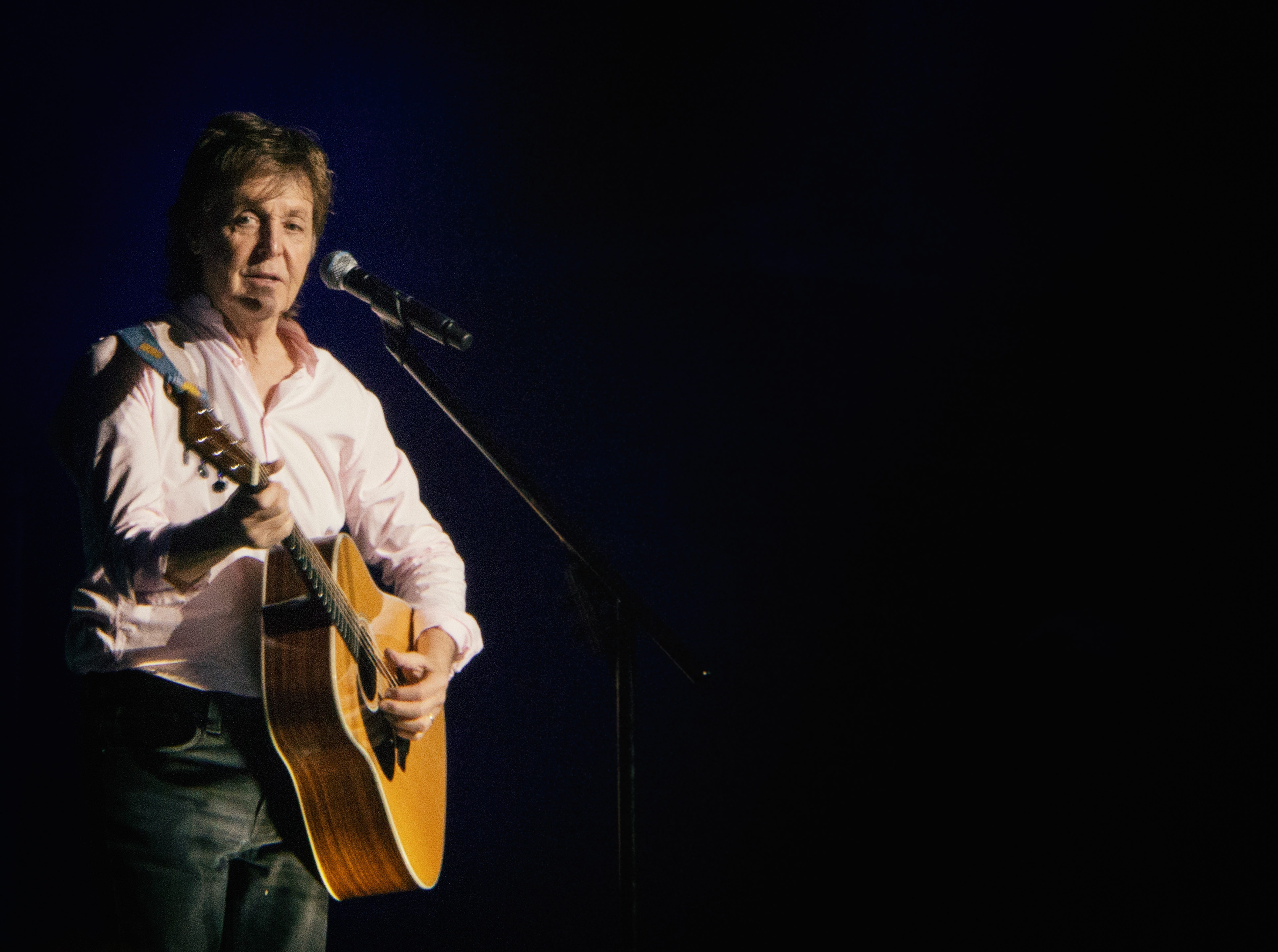
Five years ago, Paul McCartney published The Lyrics, 1956 to the Present, two heavy hardcover books totaling nearly 900 pages. Reflecting on having written “Your Mother Should Know,” in 1967, he remarked, “It all comes back to what was popular at the time, and I suppose the word ‘hit’ resonates. We were, after all, in the business of writing hits for The Beatles. Actually, I’m in the same business today. I don’t see any problem with trying to write hits. You can look at the word ‘hit’ in two ways—as either crass commercialism or trying to reach people. We knew that what made a song a hit ‘before your mother was born’ was precisely what would make a hit now and in the future.” He added, “I say ‘precisely’, but it’s actually an intangible quality that pulls us all together. It’s what makes us a worldwide community of listeners.”
I was struck by this comment in the wake of McCartney’s album The Boys of Dungeon Lane, which has, in the two weeks since its release, landed at the number one spot in seven countries, including the U.K., and the number two spot in eight countries, including the U.S.. I normally don’t care about and pay little attention to the charts, a reflex borne from decades of loving bands that are usually well under the radar, but I was inspired to check in on the commercial success of McCartney’s twentieth solo studio album after reading his remarks on crafting hits. At the age of eighty four, McCartney still calculatedly poises himself between “crass commercialism” and “trying to reach the people,” and he’s achieved both with his latest, warmly received album.
In the spirit of McCartney’s continuing successes, I decided to gather my favorite songs from his solo career, which now spans, fantastically, fifty-six years. That’s a sobering fact to this writer, who fell in love with the Beatles in the early ‘70s when the “Red” and “Blue” albums were released and the mullet-headed McCartney had yet to reach his zenith of popularity as a solo artist. A list of my favorite McCartney songs tends to be dominated by album tracks, not singles. That’s not a terribly meaningful distinction to make in McCartney’s case, as he’s so gifted a songwriter that he could bury, on side two or a b-side, or otherwise toss into the vault songs with tremendous commercial appeal, a practice at which he excelled, to the envy of onlooking artists and bands, in the 1960s and the ‘70s, and, to a lesser degree, the ‘80s. (These days, the style of McCartney’s formal/classicist songs are, to put it mildly, unfashionable.)
In his great if controversial book Revolution in the Head: The Beatles’ Records and the Sixties, the late Ian MacDonald wrote: “Shallow as much of his work is, McCartney, facing candidly out into the world, repeatedly achieves the trick of matching popular appeal with quality of expression,” adding, “If the difference between talent and genius in tune-writing lies in the degree to which a melody, more than merely catching the ear, tells an emotional story, he is beyond doubt an intermittent musical genius.” Yet, later he remarks, “Compulsively fertile in melody and fascinated by music’s formal beauties, McCartney could, when unrestrained by [John] Lennon’s cynicism, fatally neglect meaning and expression.”
MacDonald implies that such shallowness only grew in McCartney’s solo career. This is a solid take, I think, though I do feel that McCartney’s lyrics are often given short shrift, the bright commercial glare of “Uncle Albert/Admiral Halsey,” “Jet,” “Silly Love Songs,” “Coming Up,” and the like, often obscuring McCartney’s more thoughtful and philosophical songs. Yet, he can over reach lyrically—I could only listen to his 9/11 inspired “Freedom” once. McCartney himself admits that he often thinks of the words in his lyrics as musical notes, stringing them together in sonically pleasing ways regardless of whether they make “sense,” let alone reach intellectual depths. I can see MacDonald shudder.
I think I strike a balance between melody and sentiment in the list below, which isn’t a ranking of McCartney’s “greatest” or his “best” songs, but simply (and profoundly) my favorites, those songs that never fail to move me in any context, and that, to my ears, indeed show McCartney at his best, as a balladeer, a nostalgist, a rocker, a lo-fi or mildly trippy mad scientist. For fun, I set myself the task of limiting my choices, forcing myself to really narrow down to my core favorites—a tough challenge, given McCartney’s surpluses in the ‘70s and his diminishing returns in the ‘80s and ‘90s. I’ll spare you the cutting room floor evidence of my winnowing process, adding only that, with a few exceptions, I reflexively shied away from choosing overplayed or over-celebrated songs; that impulse, while it kept some of my favorites off of the list, opened the door to several tracks that I think have been neglected down the years. (I’ve written a bit about each song, and posted links to No Such Thing As Was pieces where I’ve considered a few of them at length in the past. I also added a number of “contenders,” those songs that just missed the cut, after each round.)
1970s
It was virtually impossible to narrow down to my five favorite songs from McCartney’s first decade as a solo artist, and the file of “contenders” is predictably bulging. Yet each of these, I think, displays a different hallmark of McCartney at his best, from homespun family man to Arena Rocker to balladist extraordinaire.
“Every Night” (McCartney, 1971)
The kind of relaxed, nearly flawless acoustic love song that McCartney breathes. The easy pace, beguiling melody, effortless and pleasing changes, smiling lyrics, winsome vocal: vintage Paul. This the soundtrack to the early ‘70s hippie McCartney—growing a beard, riding horses on his Scottish ranch at the end of the world, building a table from scratch and painting the roof—and gives the impression of a gentleman farmer with a guitar slung over his shoulder, his kids at his feet, and really good weed waiting upstairs. “Every Night” is one of the key songs from this laid back era.
“Let Me Roll It” (Paul McCartney and Wings, Band on the Run, 1973)
In The Lyrics, McCartney states the obvious—that “Let Me Roll It” is “a love song at its heart,” and that the title refers to rolling a joint and fucking, as well as the metaphoric “wheel of love.” He sheds some light on the song’s famous, mood-shifting guitar riff: “Anyone can understand how exposed you feel when you offer your heart to, or reveal your affections for, another person. It’s very difficult. The hesitation we feel in that situation—of wanting to reach out but being reluctant to be completely open—is made physical in the abrupt starting and stopping of the riff. The constant cutting short of the momentum of the song mimes the subject matter. We all relate to that situation.” He’d mentioned having recently seen Joe Iconis and Joe Tracz’s musical Be More Chill, which features “a nerdy boy who can’t say he loves someone. He has a speech impediment, a nervous stammer. ‘Let Me Roll It’ is a sort of long, drawn-out stammer.”
All that plus some righteous, Lennonian “bog echo” and one of McCartney’s most blissed-out choruses.
“Venus and Mars/Rock Show” (Wings, Venus and Mars, 1975)
McCartney claims to be embarrassed by this medley now due to its dated references. “The guys in Wings at that time always wanted to do ‘Rock Show’, but I was a bit reluctant,” he said in The Lyrics. “I’m describing a rock show, but I would have never called it a ‘rock show.’ I would have called it a ‘rock and roll show’… I don’t call a guitar an ‘axe’.” He added, “You’d pick up all these slang words, use them for a certain period, then move on to the next ones. But they don’t always age well. So I was really throwing all of these ideas of the planets and ‘the stars’ and the live show—all of these period words—into this one song, which I don’t perform a lot, because of the embarrassment factor.”
McCartney’s unease is striking to me, because “Venus and Mars/Rock Show” is one of his most fun and joyous songs from the era. Written as a rousing show opener—he was about to launch a full-scale tour for the first time in a decade—the medley perfectly catches the anticipation of a live show, and evokes, with an eye for telling detail, all the stuff we mythologized in the 1970s—dark, smoky arenas, louche rock stars, whacked out hangers-on, astrological signs, shady drug deals, ear-splitting decibels launched from stacks of Marshall amps. It rocks pretty hard and in a loose-limbed, casual way, not at all forced as some of McCartney’s rockers can feel. (He’s long acknowledged that this Wings lineup—himself, Linda, Denny Laine, Jimmy McCulloch and Joe English—was the strongest.) Purely of its era in some ways, “Venus and Mars/Rock Show” also captures something eternal: the appeal and heady lore of live music.
“Listen To What The Man Said” (Wings, Venus and Mars, 1975)
This gem was everywhere in the sunny summer of 1975, and it indelibly scored my adolescence, reason enough to be a lifetime favorite of mine. But more objectively speaking: what an impossibly perfect radio tune! I spent some time wrapping my head around “Listen To What The Man Said” a few years ago, here:

“Mull Of Kintyre” (Wings, single, 1977)
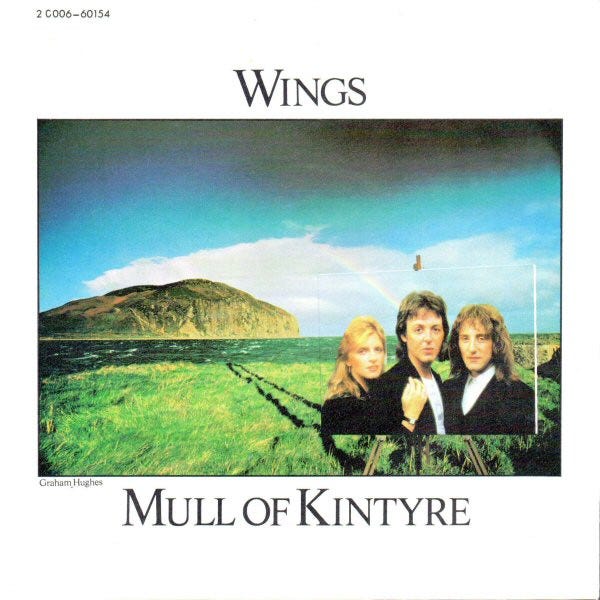
An enormous hit in the U.K., this bucolic tribute to Scotland, written by McCartney with Laine, barely dented the consciousness of many McCartney fans in the States. I first heard it on Wings Greatest, a Christmas present from my parents for me and my brother in 1978, but I wouldn’t connect with it for years. Arriving as it did as the Wings era was coming to a close (they had one big hit left in them, “With a Little Luck”) and as the noisy Punk/New Wave era was in high gear, “Mull of Kintyre” and its soaring bagpipes remained something of a curio to Americans, or to me, anyway. Now, I marvel at the song’s elementary, expressive lyrics and its gorgeous melody, as powerful an evocation of timeless, awe-inspiring natural beauty as “Rock Show” is of the sexy lure of a packed stadium.
Contenders: “That Would be Something,” “Maybe I’m Amazed,” “Another Day,” “Uncle Albert/Admiral Halsey,” “The Back Seat of my Car,” “Big Barn Bed,” “Live and Let Die,” “Country Dreamer,” “Band on the Run,” “With a Little Luck,” “Don’t Let it Bring You Down,” “After the Ball / Million Miles”
(Note: among my self-imposed requirements in putting together this list was that I ignore McCarney’s many unreleased songs. Among these is the oft-bootlegged “Waterspout,” a 1977 outtake from the London Town sessions. A typical McCartney love song featuring imaginary characters (in this case, the singer’s daddy and his lover, and her lover), “Waterspout” is charming, and—surprise!—the melody’s absurdly catchy, but what stops me in my tracks whenever I listen are Linda and Laine’s innate harmonies on the bridge behind McCartney, who’s singing near the top of his register (“Only love can get you at it and in a minute / You will find yourself swimmin' in it”). It’s all wonderfully Seventies and blissy and “Wings-ian,” among the most transcendent ten seconds in McCartney’s catalogue. If you don’t know it, take a listen.)
1980s
McCartney scored a handful of hits in the first half of the 1980s—“Coming Up,” “Ebony and Ivory,” ”Say Say Say,” “No More Lonely Nights”—but the second half, heralded by the roundly-panned Give My Regards to Broadstreet movie and soundtrack, was tough commercially. I remember watching him perform at Live Aid in 1985 and, with his not-yet-dyed graying hair, he looked, sounded, and felt like a relic to me. He’d get back up to speed, and there are plenty of gems scattered throughout the decade.
“One Of Those Days” (McCartney II, 1980)
An overlooked acoustic gem that closes the erratic McCartney II with grace—lovely, meditative, haunting yet warmly affirming in the McCartney tradition. I wrote about this beautiful song a year ago following my Dad’s death, here:

“Tug of War” (Tug of War, 1982)
In 1981, following his infamous marijuana bust and ten-day jail stay in Japan and John Lennon’s murder, McCartney folded up Wings and holed up at his home in southeast England, where he’d eventually install a full-scale recording studio. He emerged in 1982 with Tug of War, a George Martin-produced, purposely styled “comeback” album. I don’t love all of it, but the title track’s marvelous. Inspired by the metaphor of a strength contest, McCartney writes a considered, clear-eyed lyric that makes contact with universal notions of pushing and pulling, to-ing and fro-ing, mirrored nicely in the elegant and stately melody and arrangement. It could’ve collapsed under the weight of its own conceit, but doesn’t, made sturdy in part by Martin’s typically graceful and complementary production. And McCartney sings this particularly well.
“Good Times Coming/Feel the Sun” (Press to Play, 1986)
Another overlooked song, to my ears one of the few highlights on the dated Press to Play album. For decades, McCartney’s gathered unfinished, or scraps of, songs and assembled them into medleys; some stick, some don’t. The glossy “Good Times Coming/Feel the Sun” is an especially attractive pairing, the first song spookily evoking childhood vacations and adults’ dark nostalgia before sprinting into an upbeat chorus, the second a spirited, grateful celebration of love and sunshine on your face (and probably weed). Uncontroversial, inconsequential, and I sing it for hours after I listen to it, properly moved, my mood adjusted and brightened. There’s little more that you can ask of a pop song.
“Once Upon a Long Ago” (single, 1987)
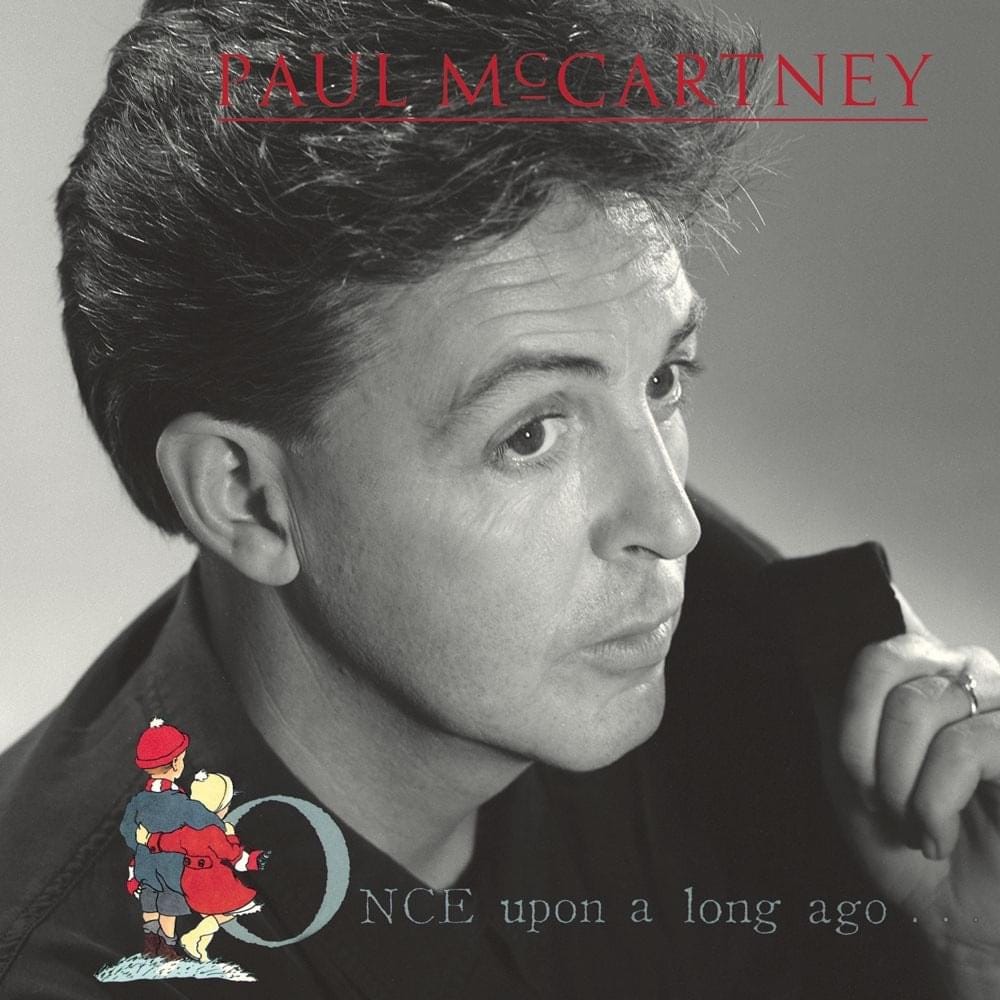
A decade after receiving Wings Greatest from my parents, I bought myself a Christmas present, McCartney’s All the Best!, released in 1987. I was in college, obsessed with punk rock and alt and indie music, yet I still (though shyly) had an ear cocked to McCartney, whose songs, along with the Beatles’, I’d play on my radio show at WMUC at the University of Maryland. Wings Greatest had vanished from my record collection at some point, and so I bought All the Best! to fill the gap.
What I didn’t know was what was missing. “Once Upon a Long Ago” was released as a single in the U.K. to promote All the Best!, but it wasn’t issued in the U.S, nor included on the album. I wouldn’t hear it for years, and when I did I discovered a lovely song, one of his finest of the’80s. In a reflective mood, McCartney strings together quasi-nonsense lyrics drifting within nostalgia for the quirkiness of adolescence; the chorus is among his best from the era, powerful and affecting. The real treat, however, occurs in the second half, when for over a minute the song devolves into an instrumental passage, McCartney chanting wordlessly while stray licks from the melody rise and fall in conjuring reverb, a trippy, inward-gazing reverie that, unfortunately, is interrupted by a guitar solo that closes the song.
“This One” (Flowers in the Dirt, 1989)
McCartney’s true comeback album arrived as the decade closed and McCartney was gearing up for another worldwide tour, the biggest and most ambitious of his career to date. What excited me more was word that McCartney had written some songs with Elvis Costello, which appeared on Flowers in the Dirt (“My Brave Face,” “You Want Her Too,” “Don’t Be Careless Love,” and “That Day Is Done”) and on subsequent albums released individually by the two. (The best, in my opinion, are “Veronica,” on Costello’s Spike, and “The Lovers That Never Were,” on McCartney’s Off the Ground.) The somewhat airless Flowers in the Dirt suffers from tame production and polite performances, though those two qualities are ideal for this tune, another of McCartney’s “regret” songs, which, though they don’t rival his former songwriting partner Lennon’s for emotional rawness, find McCartney getting his hands around some mature stuff. (“Couldn’t I have given you a better life?” he wonders.) What wins the day here is the exuberant melody, gently rising and falling as the singer reckons with his inability to act in the past as he resolves to turn the present moment into a secure future.
Contenders: “Coming Up” [live], “Summer’s Day Song,” “Put It There”
1990s
Distracted in the first half of the decade by the consuming production tasks and new recordings for the Beatles’ ambitious Anthology project, gutted in the second half by his wife Linda’s illness and death, McCartney treaded water for much of the 1990s. He emerged near the end of the decade with one of his strongest albums yet.
“Hope of Deliverance” (Off the Ground, 1993)
Another in a long line of classic ready-for-radio songs, “Hope for Deliverance” didn’t assault the U.S. airwaves in the ‘90s as assertively as Wings’ songs did in the ‘70s; it wasn’t for lack of trying, as the Top 100 was simply a far less hospitable terrain in the Grunge, Boy Band, and hip hop era. McCartney wrote this at home in his attic, to where he’d dragged a twelve-sting Martin acoustic guitar; attaching a capo, he discovered that the guitar sounded “much more jingly,” which reminded him “of Christmas and churches,” he remarked in The Lyrics. “Maybe that’s what led me to the idea of hope and deliverance.” Interested in how humans and animals strive “to get out of the dark,” McCartney composed an upbeat song that he conceived as a gesture of aid to his listener, resolving, as always, to marry the world’s woe and strife to music’s pleasures and elations. McCartney has said that his current band often warms up with this number in rehearsals or while tuning up before they hit the stage. A heralding mood, indeed.
“Somedays” (Flaming Pie, 1997)
“Calico Skies” (Flaming Pie, 1997)
“Great Day” (Flaming Pie, 1997)
A wonderful trio of acoustic-based songs from Flaming Pie, a strong record that signaled a creative renewal for McCartney (cast in shadow in its early phase by his Linda’s death). “Calico Skies” and “Great Day” harken back to McCartney’s early solo years, the impression given of a man alone with his acoustic guitar working through life’s trials and joys. “Calico Skies” sports a joyful, dancing melody in service to a lyric celebrating the headiness of a fated romance, while “Great Day” is a smiling, stoner’s ode a family cozying up at home, greeting each day as the gift it is. These two reflect McCartney at his large-hearted best.
Meanwhile, the haunting “Somedays” is among McCartney’s greatest songs. He allegedly wrote it while Linda was doing filming promotional interviews for one of her cookbooks. Surrendering, as a kind of challenge, to the pressures of writing within a limited time, this seemed, paradoxically, to free him to wander into and consider thoughtful and provocative ideas. Graced by a George Martin orchestration score, the wise, melancholy lyrics and the lovely, stately melody are powerfully affecting, like “One of these Days” revealing the mature, philosophical side of McCartney, the songwriter whose joy can originate in playful, trivial imaginings or in the magic created when someone sits with a guitar, brooding, distracted, touched by that curious blend of loss and optimism.
“No Other Baby” (Run Devil Run, 1999)
The only cover song on this list, the earthy, sexy “No Other Baby,” originally recorded in 1958 by the Vipers, a skiffle group, could’ve been written by McCartney, so commandingly does he step into the song’s persona. I wrote about this recording and the song’s history a while back, here:

Contenders: “Off the Ground,” “Young Boy,” “Little Willow,” “Movie Magg”
2000s
The last three decades have found McCartney on a roll. He writes, records, release albums, and tours, all the while continuing to steward the Beatles’ legacy.
“Your Way” (Driving Rain, 2001)
Doing what Sir Paul does best here, writing pop songs that originate in the ballad tradition and gain dimension and textures in the recording process. The melody in “Your Way” is a particularly pleasing—it might’ve been plucked from the air at any time in his career—and also notable in that, for the first time, it’s sung by a man whose preternaturally gifted, wide-ranging voice is beginning to face its limits. McCartney’s unhappy fate as a singer was that he wrote decades worth of songs with richly expressive, wide-ranging melodies—and then he aged. The voice is no longer quite there, yet, to quote a phrase, the songs remain the same. In recent years, McCartney seems to have adjusted for this, writing melodies with narrower intervals and fewer changes, yet he continues to sing his older songs onstage, which his both his right and a point of contention for a certain segment of his fan base. On “Your Way,” the melody and the voice that sweetly sings it are in fine complement.
“Dance Tonight” (Memory Almost Full, 2007)
“Ever Present Past” (Memory Almost Full, 2007)
“You Tell Me” (Memory Almost Full, 2007)
Another trio of songs that shows McCartney at his Late-Era best: the writer of cheery singalongs who can be nostalgic and reflective, too. The ukulele-driven “Dance Tonight” is vintage McCartney, a laid back, smiling melody with an irresistible invitation—“Well, you can come on to my place if you want to / You can do anything you wanna do”—sounding as if it tossed it off in a moment of pure contentment. Conversely, the assertive “Ever Present Past” is written by a man reckoning with the fact that he’s already lived the bulk of his life; looking back, startled yet grateful, he’s “searching for the time that has gone so fast / The time that I thought would last / My ever present past.”
Its more absorbed flip-side is the wonderful “You Tell Me,” an acoustic, mid-paced song sung by McCartney near the top of his range. Moving among striking changes that create an unstable mood, the singer wonders on the accuracy of his memories, depending on the person he’s with to corroborate or gently correct him. The bridge—
Were we there? Is it true?
Was I really there with you?
Let’s see
You tell me
—opens a brief window onto uncertainty, not a place where McCartney often dwells in song. Yet I love it when he does, as it tempers with shadows the well-lit sweetness in which he usually traffics. “You Tell Me” is a late-career gem.
“Sing the Changes” (The Fireman, Electric Arguments, 2008)
From one of three experimental albums McCartney’s created with British musician and record producer Martin Glover under the name the Fireman (the others are Strawberries Oceans Ships Forest and Rushes), “Sing the Changes” is a trippy delight, opening with a dramatic, crying guitar coupled with ascending and descending lines and then blossoming into a lyric celebrating the simple mysteries around us. The song’s an anthem that’s essentially about itself, the melody and arrangement a sonic tribute to music, delight, and wonder: “Sing your praises as you're sleeping / Feel the quiet in the thunder / Sing the changes calling over / Everybody has a sense of childlike wonder.”
Contenders: “She’s Given Up Talking,” “Vanilla Sky,” “Jenny Wren,” “Anyway,” “Certain Softness,” “See Your Sunshine,” “(I Want to) Come Home”
2010s
“Early Days” (New, 2013)
“New” (New, 2013)
Again, McCartney playing off of his strength while recognizing that those strengths are assuming different shapes as he ages. A precursor to the memory-laden work on The Boys of Dungeon Lane, “Early Days” finds McCartney explicitly referencing Lennon and the Beatles, both in the memories that he possesses and in the often inaccurate myths that have been written about them. What’s moving is how, in facing the past and its leaking into the present, McCartney steps more carefully now with his voice, eschewing studio affects as he sings the verses with an unmistakable quiver and the bridge with a falsetto less sure than what he’d depended on, and likely took for granted, all those years ago. His vocal gives the simply stark line “I lived through those early days” all the gravitas it needs.
And then there’s “New,” a bright, bouncing, “Penny Lane”-esque love song that disperses any concern one might have for how McCartney might deal with his maturing voice. Here, his falsetto is lovely and sure, in service of one of the more joyous pop songs that he’s written for some time. Might’ve been a smash hit in another decade.
“Dominoes” (Egypt Station, 2018)
I’m hesitant to describe the lovely “Dominoes” as Mature McCartney, because he’s often sung about the parts that love and friendship play in fate and chance, that old mystery, but written by a man in his mid-70s, those sentiments gain—have earned—ballast. He’s again smartly trusting his falsetto in the verses, but drops down again into his recognizable midrange for the striking chorus, where enormous dominoes fall and crush everything beneath them, a kind of naturalistic shoulder shrug that’s dressed up with optimism and a grin. “Dominoes” is yet another in a long line of wise songs that are sometimes missed given the extraordinary breadth of McCartney’s career.
Contenders: “Always,” “Confidante”
2020s
“Slidin’” (McCartney III, 2020)
“Slidin’” began as a soundcheck jam. “I started jamming and this riff came out that I liked and so we developed that and I thought ‘I must do something with that’,” McCartney remarked in 2020 in NME. “I really liked it as a riff, it stayed in my brain, so we did and recorded it for Egypt Station with my band but it didn’t work out, so I had it kind of half finished so I changed some things here and there and put lyrics on it and so it became this.”
What “this” is is a stomping, psychedelic ode to flying, written just before the COVID pandemic but in its yearning to break lose and go somewhere, it was a virtual anti-anthem for lockdown—
I know there must be other ways of feeling free
But this is what I wanna do, who I wanna be
Every time I try, I feel like I can fly
But I know that I could die trying
That’s what I heard, anyway, especially in the trippy chorus, where the singer breaks out and takes wing, yet how, where—in a dream? while stoned or tripping? in a song? at the end of the street? “I can see my body through windows in my hair,” he sings, and I love the idea of McCartney, forty years after McCartney II, a half century after McCartney, at his home, surrounded by gear, the world outside a world away, a song in his head.
“Days We Left Behind” (The Boys of Dungeon Lane, 2026)
I haven’t lived long enough with McCartney’s latest to be able to take purchase on its strengths and weaknesses; those will arrive over time. On first listens I did like “As You Lie There,” “Down South,” “Life Can be Hard,” “Home to Us,” and “First Star of the Night,” with their blend of ease and loss. Yet I was immediately struck by “Days We Left Behind,” a beautiful acoustic ballad exploring what’s now become McCartney’s most fertile subject: the past. The verses are again preoccupied with familiar places and figures (“smoky bars and cheap guitars,” “the Mersey shore,” “Forthlin Road,” the War), but a new mood arrives with the chorus, elegantly yet sadly moving among D, C, and chords—
Nothing ever stays
Nothing comes to mind [And no one needs to cry]
No one can erase [No one is to blame]
The days we left behind
—where Paul McCartney arrives, again, at that place that’s defining these late albums: graphic details from a startling past drifting away, only to return, the tick tock of gain and loss. The first time I listened to “Days We Left Behind,” I was excited to return to that lovely chorus once he’d sung it the first time, an anticipation I hadn’t felt quite so keenly in one of his songs for a long time. I hope that there will be surprises tomorrow, too.
Contenders: “Winter Bird/When Winter Comes”
You might also dig:
The many shapes of sacredness

I’m generally adverse to Christmas music. There are plenty of reasons for this, yet writing about my low tolerance for seasonal music seems annoying, a churlish gesture in this month with no point but to be contrarian. Viva all who crank the Yuletide tunes!
From this moment on

I don’t wish, and I certainly don’t need, to add to all of the talk about the Beatles re-released Anthology collection, only to remark at the predictable blend of rapture and furor that the band’s reissues tend to inspire. From overpraise out of the mouths of blinkered apostles to dismissive complaints from skeptical fans about what was and/or wasn’t in…
All their little plans and schemes

Time is a perpetual motion machine. And consider, also, its alarming elasticity. With the Beatles’ release of “Now and Then,” we’re as far from “Free As A Bird” now as “Free As A Bird” was from Sgt. Pepper’s Lonely Hearts Club Band. And an analogy suggests itself: “Free As a Bird” and “Real Love” are to
Paul McCartney by Dorothe / 470 Images via Public Domain
Great article. Thanks for taking time to curate the massive catalog to pull out the gems. I’ll need to put a playlist together and kick back for a joyful afternoon of music. Look, Paul could have never written another song after his last session as a Beatle and his legacy as one of our greatest songwriters would have been cemented. Instead he did what anyone who dares to call themselves a songwriter - he continued to write songs. All of us should be grateful for his continued pursuit. To judge the Sir Paul post-Beatles catalog against what he created WITH three other GREAT artists is IMHO a pointless comparison. I applaud you for not falling into that trap and instead evaluate his work for its own merit and boy there is so much to celebrate. Not the least of which is the pure joy and fun that McCartney infuses in so much of his work. Just look at the public’s response to his appearance on Colbert’s final show - joy is the ultimate expression of resistance. Maybe I’m amazed and it sure feels good.
A terrific article.